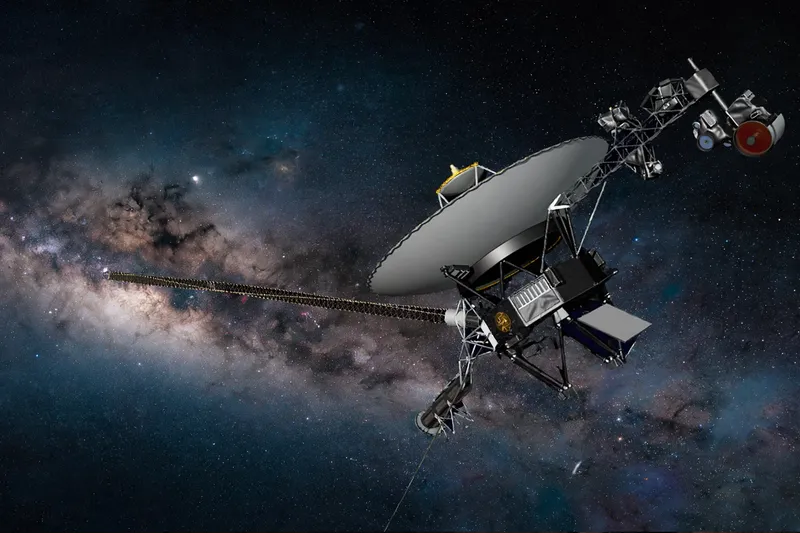
Voyager Leaves the Solar System: A Message in the Dark
Launched in 1977, two probes toured the planets and kept going. In 2012, Voyager 1 crossed into interstellar space the first human-made object to leave the Sun's realm.
WOW Score
In 1977, NASA launched twin Voyager probes to tour the outer planets. They did and then, powered by decaying plutonium, they kept flying outward into the dark.
In 2012, Voyager 1 crossed the heliopause, the boundary where the Sun's wind yields to interstellar space. Nothing made by humans had ever gone so far.
"Still transmitting from beyond the Sun's winds, Voyager carries a golden record a hello from Earth to whoever, or whatever, might find it."
Voyager gave us the first close-ups of Jupiter, Saturn, Uranus, and Neptune, then crossed into interstellar space. Its golden record is humanity's message in a bottle, drifting for a billion years.
The Full Story
The Grand Tour
A rare planetary alignment let a single spacecraft visit multiple giant planets. Voyager 1 swept past Jupiter and Saturn; Voyager 2 went on to Uranus and Neptune still the only craft to have seen them up close. The images rewrote textbooks.
The Golden Record
Each Voyager carries a gold-plated phonograph record: 115 images, natural sounds, music from many cultures, and a greeting in 55 languages. Conceived by Carl Sagan's team, it is a deliberate message to any alien finders a portrait of Earth in sound and image.
Crossing the Threshold
The heliopause is where the solar wind's pressure finally falters against the gas between stars. In 2012, Voyager 1's instruments showed a sharp drop in solar particles and a rise in cosmic rays. It had, quietly, left the Sun's domain.
Still Talking
Voyager 1 is now over 24 billion kilometers from Earth; its signal, traveling at light speed, takes more than 22 hours to arrive. Engineers power down instruments one by one to stretch its nuclear batteries into the 2020s. Even silent, it will coast for millennia.
A Bottle in the Cosmos
Voyager is less a machine than a message. It carries proof that a species on a small blue world once looked up, built something to leave, and said, in every language it knew: we were here, and we wondered. That, perhaps, is the most human thing we have ever launched.
Related Turning Moments
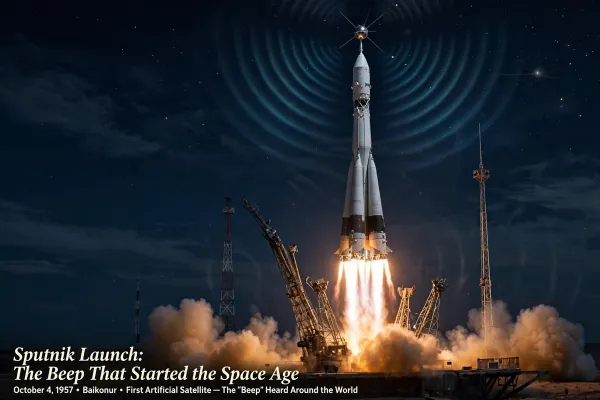
Sputnik Launch: The Beep That Started the Space Age
On 4 October 1957, a polished metal ball the size of a beach ball began circling Earth, beeping. It had no crew, no flag and it changed the 20th century overnight.
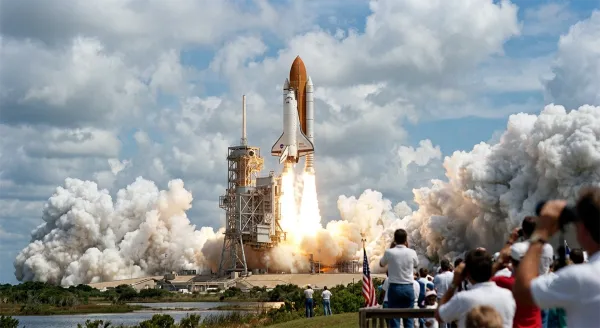
Hubble Telescope Launch: A Clouded Eye That Learned to See
In 1990, a school-bus-sized telescope rose into orbit then sent back blurred pictures. The most ambitious eye on the universe had been built with a flawed mirror.
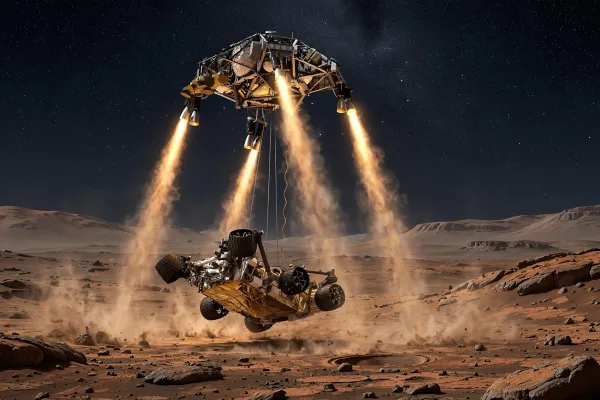
Mars Rover Landing: Seven Minutes of Terror
In 2012, a car-sized robot named Curiosity fell toward Mars at 21,000 km/h. For seven minutes, no one on Earth could help. Then a signal: 'Touchdown confirmed.'