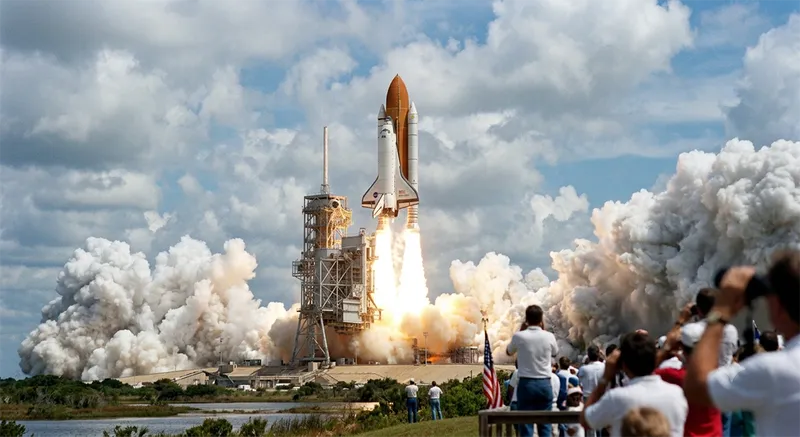
Hubble Telescope Launch: A Clouded Eye That Learned to See
In 1990, a school-bus-sized telescope rose into orbit then sent back blurred pictures. The most ambitious eye on the universe had been built with a flawed mirror.
WOW Score
In 1990, the Hubble Space Telescope launched aboard Discovery, promising views unclouded by Earth's atmosphere. The first images were devastatingly blurry: the mirror had been ground to the wrong shape.
A breathtaking in-space repair three years later fixed it. Hubble then spent decades delivering the deepest portraits of the cosmos ever made.
"A flawed mirror nearly blinded the costliest telescope ever built. Astronauts flew up and gave it new eyes and it changed our view of the universe."
After a 1993 repair, Hubble delivered the Deep Field and measured the universe's expansion age and rate. It became humanity's shared window on cosmic history and a symbol of what repair, not just launch, can achieve.
The Full Story
An Eye Above the Sky
Named for astronomer Edwin Hubble, the telescope was designed to sit 540 kilometers up, circling every 95 minutes, free of the atmospheric blur that limits ground observatories. It was decades in planning and the most expensive science instrument of its time.
The Blurred Mirror
Shortly after launch, scientists realized Hubble could not focus. A measurement error during manufacturing had left the primary mirror slightly too flat by about the width of a human hair. The shame was public and painful; the telescope seemed a billion-dollar failure.
The Rescue
In 1993, astronauts performed a daring series of spacewalks to install corrective optics essentially eyeglasses for the telescope. The fix worked flawlessly. Hubble snapped into focus, and the world saw what it had paid for.
The Deep Fields
Pointing Hubble at a seemingly empty patch of sky for ten days, astronomers captured the Hubble Deep Field: thousands of galaxies in a speck of darkness, some billions of light-years away. It revealed the universe's immense age and structure as never before.
A New View of Everything
Hubble measured the universe's expansion rate, found evidence of supermassive black holes, and tracked comets striking Jupiter. It became a cultural icon proof that even a broken giant can be mended, and that our curiosity reaches far beyond our own pale blue dot.
Related Turning Moments

The Challenger Disaster: When the Sky Turned to Grief
On 28 January1986, a shuttle lifted off before a nation's schoolchildren and 73 seconds later broke apart in a fountain of fire. America's faith in the heavens fractured.
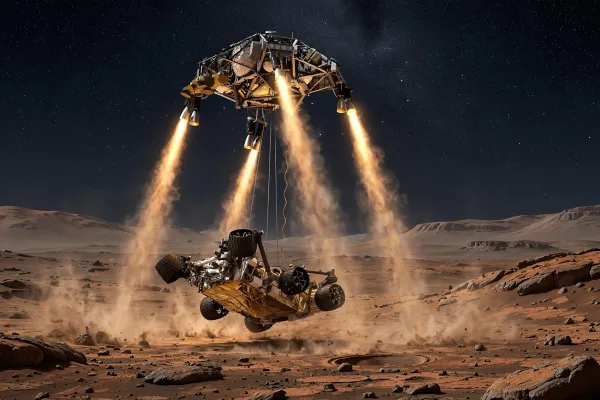
Mars Rover Landing: Seven Minutes of Terror
In 2012, a car-sized robot named Curiosity fell toward Mars at 21,000 km/h. For seven minutes, no one on Earth could help. Then a signal: 'Touchdown confirmed.'
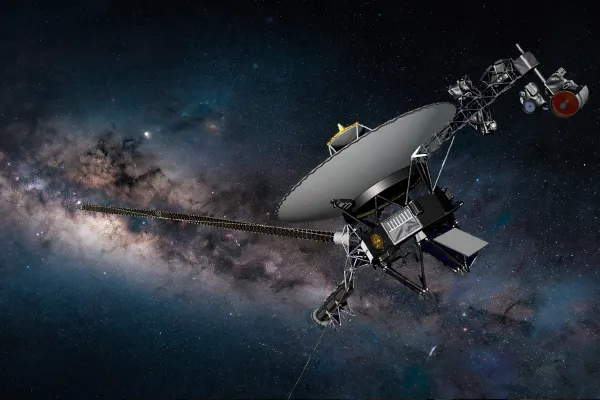
Voyager Leaves the Solar System: A Message in the Dark
Launched in 1977, two probes toured the planets and kept going. In 2012, Voyager 1 crossed into interstellar space the first human-made object to leave the Sun's realm.