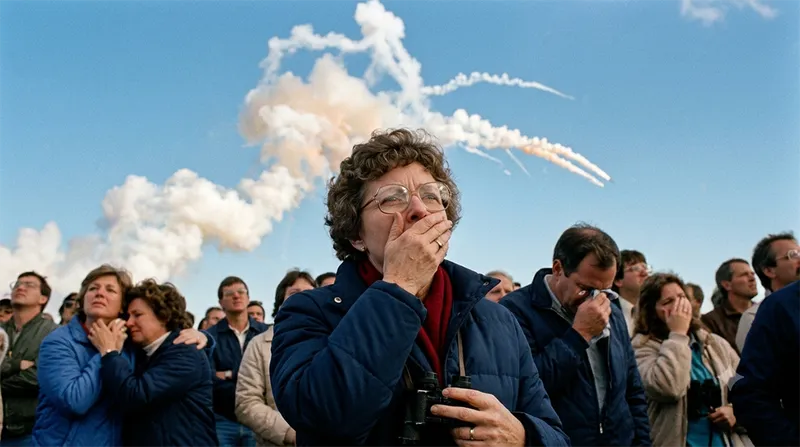
The Challenger Disaster: When the Sky Turned to Grief
On 28 January1986, a shuttle lifted off before a nation's schoolchildren and 73 seconds later broke apart in a fountain of fire. America's faith in the heavens fractured.
WOW Score
In 1986, the space shuttle Challenger broke apart 73 seconds after launch, killing all seven aboard including Christa McAuliffe, a teacher chosen to teach from orbit.
The cause was known in advance and voiced by engineers who were overruled. The disaster became a lesson in how institutions silence the truth.
"The O-ring didn't fail in the sky. It failed in a meeting, where a warning was overruled by a schedule."
Challenger forced NASA to confront a culture that ignored engineers, reshaped safety oversight, and grounded shuttles for years. It remains the case study for how organizations trade lives for deadlines.
The Full Story
A Teacher in Space
NASA's 'Teacher in Space' program put Christa McAuliffe, a New Hampshire social-studies teacher, aboard Challenger to teach lessons broadcast to schools. Millions of children watched the launch live, making the tragedy uniquely personal for a generation.
The Warning
Engineers at contractor Morton Thiokol had flagged the shuttle's rubber O-rings, which sealed joints in the solid rocket boosters. Cold weather the night before launch made them brittle. They recommended a delay. Under pressure to keep to the schedule, managers overruled them.
Seventy-Three Seconds
At liftoff the cold O-ring failed, letting hot gas escape. The booster broke free and tore the fuel tank apart. The crew cabin fell from 14 kilometers; all seven died. The nation watched the plume split into a fatal 'Y' in real time.
The Truth Told
Physicist Richard Feynman, on the presidential commission, demonstrated the O-ring's failure with a simple piece of ice and a clamp on television. His bluntness exposed how managers had set aside engineering judgment. The report condemned NASA's flawed decision-making.
A Safer, Slower Spaceflight
Shuttles flew again only after a 32-month pause and sweeping reforms. Challenger became the enduring case study in 'groupthink' and whistleblowing proof that the most dangerous failure in any high-tech endeavor is an organization that stops listening to the people who know.
Related Turning Moments
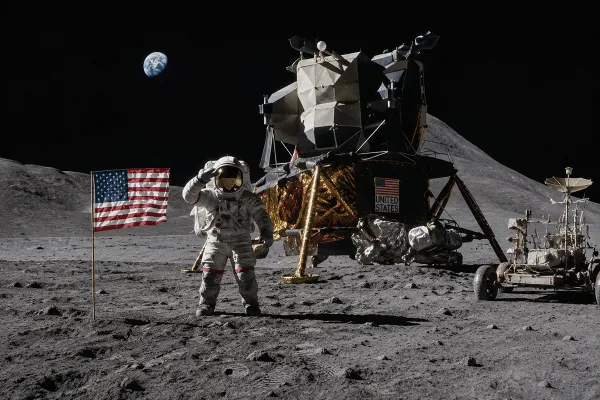
Apollo 11 Moon Landing: One Small Step, One Giant Leap
On 20 July 1969, half a billion people held their breath as a fuzzy black-and-white image showed a boot pressing into lunar dust. Humanity had left its home planet.
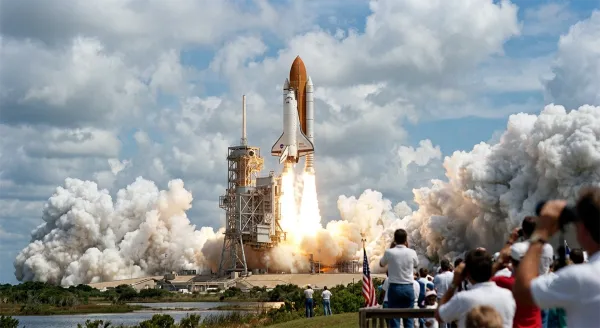
Hubble Telescope Launch: A Clouded Eye That Learned to See
In 1990, a school-bus-sized telescope rose into orbit then sent back blurred pictures. The most ambitious eye on the universe had been built with a flawed mirror.

International Space Station Begins: A Lab Above the Nations
In 1998, pieces launched from rival superpowers met in orbit and were bolted together by hand. The cold War's enemies built a home in the sky.