
Newton Discovers Gravity: The Apple That Fell on All of Science
A fallen apple. A young scholar in isolation. In a single year of plague, Isaac Newton rewrote the rules of the universe and we've been living under them ever since.
WOW Score
In 1666, with Cambridge closed by the Great Plague, a 23-year-old Isaac Newton retreated to his family's orchard. Legend says an apple fell, and he asked a deceptively simple question: why should it fall straight down and why shouldn't the same pull reach all the way to the Moon?
That question became a universal law. By 1687, Newton showed that every mass attracts every other mass, and that a single inverse-square rule explained both a tumbling apple and the orbit of planets. The cosmos suddenly had a user manual.
"The same force that dropped an apple also held the Moon in the sky Newton made the heavens and the Earth speak the same language."
Newton's law of universal gravitation united heaven and Earth under one mathematics, launched classical physics, enabled the prediction of comets and tides, and gave engineers the tools to later put satellites and astronauts into orbit. Every rocket launch is still a negotiation with his equations.
The Full Story
A Year in Isolation
The plague years of 1665–1666 emptied England's universities. Newton used the forced solitude as few others could, later calling it his 'year of wonders.' Free from lectures and obligations, he attacked problems in mathematics, optics, and motion with relentless focus. The apple story, told by Newton himself in old age, is less about the fruit than about a mind refusing to accept that Earth and sky obeyed different rules.
One Rule for Earth and Sky
Before Newton, the fall of an apple and the motion of the Moon were thought to belong to separate realms the messy sublunar world versus the perfect heavens. Newton's insight was that gravity is universal: every particle of matter pulls on every other, with a force that weakens as the square of the distance. The same equation that makes an apple drop also keeps the Moon circling Earth.
The Principia
Newton published his findings in 1687 as the Principia Mathematica. In it he laid out three laws of motion and the law of gravitation, deriving Kepler's planetary ellipses from first principles. The book is often called the greatest scientific work ever written. It turned physics from a collection of observations into a predictive, mathematical science.
What It Unlocked
With gravity in hand, scientists predicted the return of Halley's Comet, explained the tides, and calculated the shape of the Earth. Centuries later, the same maths guided the launch of Sputnik, the Apollo missions, and every GPS satellite overhead. Newton's framework was so powerful that it described the world accurately for over 200 years, until Einstein revealed its limits.
The Lasting Legacy
Newton did not 'discover gravity' in the sense that no one had felt it before. He discovered the law behind it a single, elegant rule that made the universe legible. From falling apples to falling smartphones, from ocean tides to spaceflight, we still live inside the world Newton described. As he humbly put it, he had only stood on the shoulders of giants.
Related Turning Moments
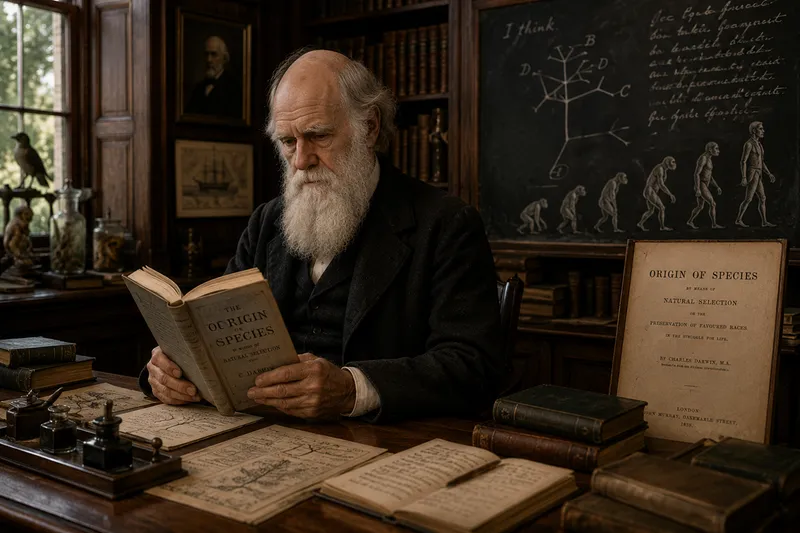
Darwin Publishes Evolution: The Book That Moved Humans Off the Pedestal
After 20 years of silence, a shy naturalist published a single book that explained where every living thing comes from and changed how humanity sees itself forever.
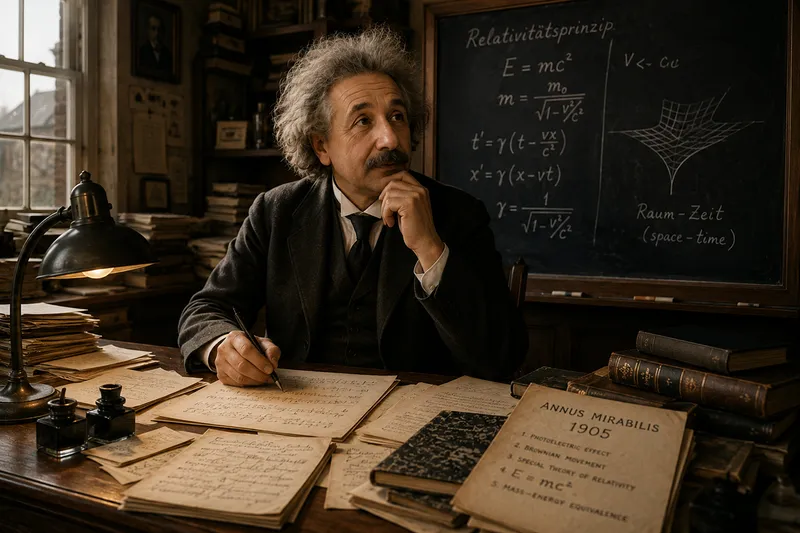
Einstein's Theory of Relativity: The Year a Clerk Rewrote Time
In 1905, a 26-year-old patent clerk with no university job published four papers that shattered Newton's universe. One of them said time itself is not absolute.

The DNA Double Helix: The Spiral That Spelled Life
In 1953, two young scientists pieced together a twisted ladder from scattered data and suddenly humanity could read the instruction book of every living thing.