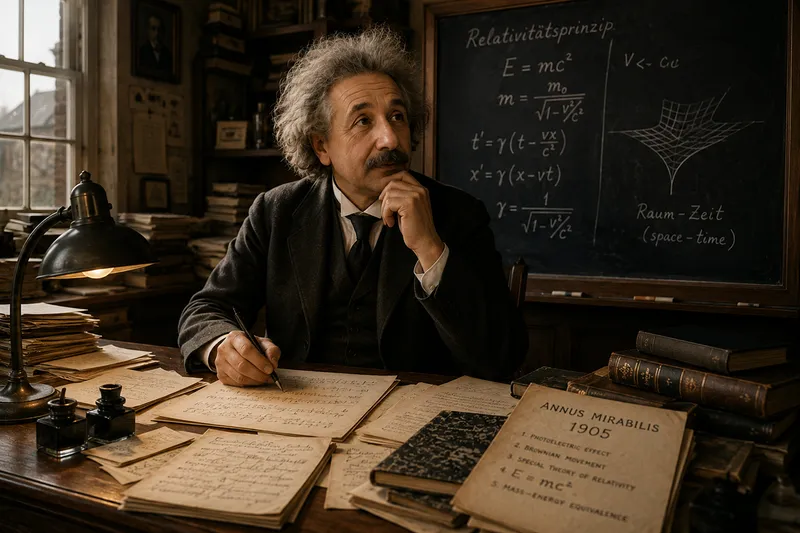
Einstein's Theory of Relativity: The Year a Clerk Rewrote Time
In 1905, a 26-year-old patent clerk with no university job published four papers that shattered Newton's universe. One of them said time itself is not absolute.
WOW Score
In his 'miracle year' of 1905, Albert Einstein published papers on light, atoms, and motion and then special relativity, which showed that time slows and space stretches depending on how fast you move.
A decade later, general relativity reframed gravity not as a force but as the curving of space-time itself. The universe has never looked the same since.
"Imagination is more important than knowledge. For knowledge is limited, whereas imagination embraces the entire world."
Relativity gave us E=mc², nuclear energy, GPS corrections, black holes, and the expanding universe. It overturned common sense about space and time and became the foundation of modern cosmology and all high-energy physics.
The Full Story
The Miracle Year
Working at the Swiss patent office, Einstein had no lab and few colleagues. In 1905 alone he explained the photoelectric effect (seeds of quantum theory), proved atoms exist, and unveiled special relativity. Each paper alone could have secured a career. Together they remade physics in twelve months.
Time Is Not Absolute
Special relativity starts from two stubborn facts: the laws of physics are the same for all observers, and the speed of light is always constant. The consequence is strange moving clocks tick slower, and lengths contract. There is no universal 'now.' Time and space are woven into a single flexible fabric called space-time.
E = mc²
Buried in relativity was the era's most famous equation: energy equals mass times the speed of light squared. It meant mass is frozen energy, and a tiny amount of matter holds a staggering amount of it. This insight eventually powered both nuclear reactors and nuclear weapons.
Gravity as Curved Space
In 1915, general relativity went further, replacing Newton's force with geometry: mass and energy bend space-time, and objects follow those curves what we feel as gravity. It predicted light bending around the Sun, gravitational waves, and black holes, all later confirmed with breathtaking precision.
The World It Built
Every GPS satellite must correct for relativistic time dilation or your maps would drift by miles a day. Nuclear power, particle accelerators, and our picture of the Big Bang all rest on Einstein. He didn't just add to physics he changed what reality is allowed to be.
Related Turning Moments
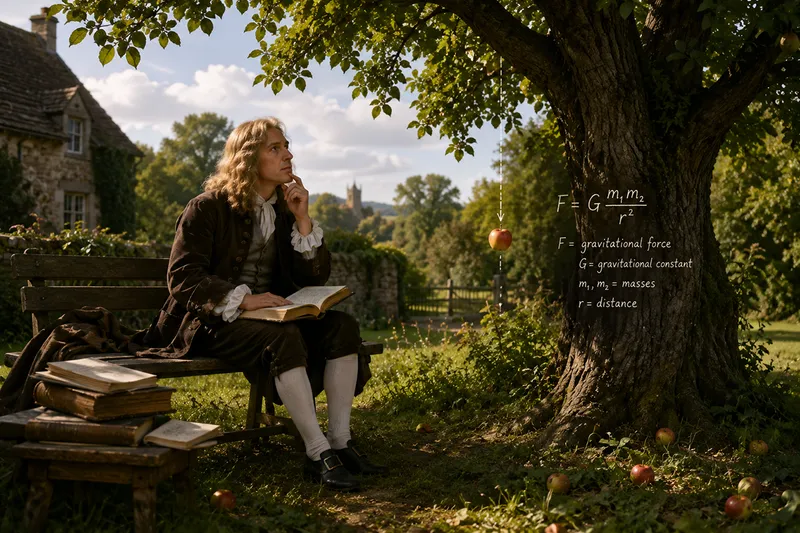
Newton Discovers Gravity: The Apple That Fell on All of Science
A fallen apple. A young scholar in isolation. In a single year of plague, Isaac Newton rewrote the rules of the universe and we've been living under them ever since.
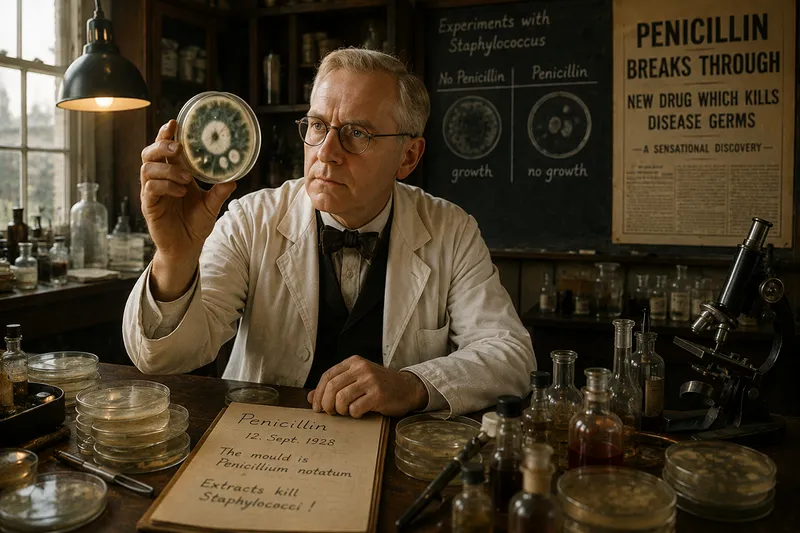
Penicillin Discovered: The Mould That Conquered Death
A forgotten petri dish, a contaminated mess, and a scientist with the eyes to see it. In 1928, a stray mould began killing bacteria and changed medicine forever.

CRISPR Gene Editing: Life's Own Word Processor
A bacterial immune system, repurposed by scientists, became a find-and-replace tool for DNA. In 2012, we learned to edit the code of life itself.