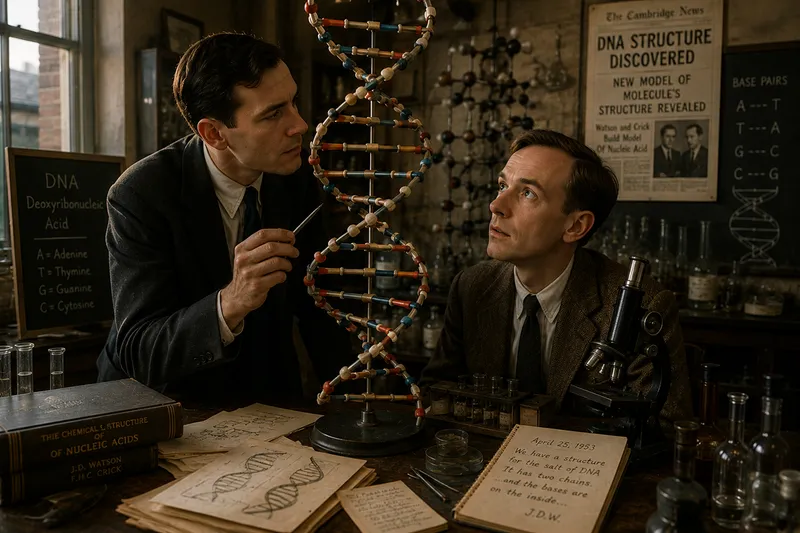
The DNA Double Helix: The Spiral That Spelled Life
In 1953, two young scientists pieced together a twisted ladder from scattered data and suddenly humanity could read the instruction book of every living thing.
WOW Score
In February 1953, James Watson and Francis Crick built a model of DNA as two intertwined strands a double helix. The shape explained, at a stroke, how life copies itself.
Their one-page paper in Nature is among the most consequential ever published. It turned biology into an information science and gave us the power, eventually, to read and rewrite our own genes.
"We wish to suggest a structure for the salt of deoxyribose nucleic acid (DNA) a structure so simple, it was almost certainly right."
The double helix revealed how life stores and copies information, launching molecular biology, genetic engineering, forensic DNA, and personalized medicine. It turned heredity from mystery into a readable code.
The Full Story
The Race for the Code
By the early 1950s, scientists knew genes were made of DNA, but no one knew its structure. Competing teams Linus Pauling in California, and Rosalind Franklin and Maurice Wilkins in London chased the answer. Watson and Crick, at Cambridge, took a different tack: build a physical model and test it against the data.
Franklin's Crucial Photograph
Rosalind Franklin's X-ray diffraction work at King's College produced 'Photo 51,' a startlingly clear image suggesting a helical structure with repeating regularity. Without her knowledge, her data reached Watson and Crick. That image was the key that let them see the helix's dimensions and rules.
The Two Strands
The breakthrough was the pairing rule: adenine pairs with thymine, and guanine with cytosine. Because each strand complements the other, the molecule can unzip and serve as a template for an exact copy. Life's hereditary information was, at bottom, a four-letter chemical alphabet.
A One-Page Paper
On 25 April 1953, Nature published the discovery in a famously modest single page, ending with the understatement that the structure 'suggests a possible copying mechanism for the genetic material.' Watson, Crick, and Wilkins later shared a Nobel Prize. Franklin had died of cancer in 1958 and was not eligible.
The Spiral That Changed Everything
Once the code was legible, biology exploded: genetic engineering, DNA fingerprinting, gene therapy, and the sequencing of entire genomes all descend from this spiral. We can now edit genes (see CRISPR) because we finally understood the book we were editing.
Related Turning Moments
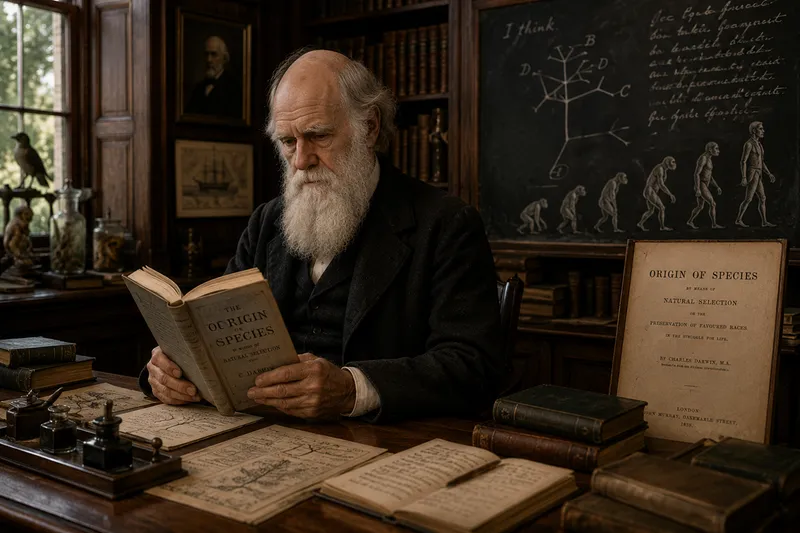
Darwin Publishes Evolution: The Book That Moved Humans Off the Pedestal
After 20 years of silence, a shy naturalist published a single book that explained where every living thing comes from and changed how humanity sees itself forever.

The Human Genome Project: Reading the Book of Us
It took 13 years, billions of dollars, and an international army of scientists to spell out the 3 billion letters of human DNA. In 2003, we finally read ourselves.
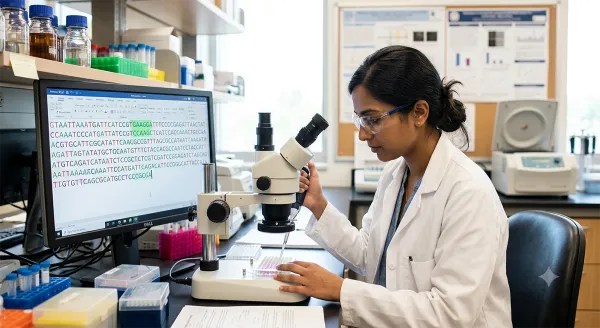
CRISPR Gene Editing: Life's Own Word Processor
A bacterial immune system, repurposed by scientists, became a find-and-replace tool for DNA. In 2012, we learned to edit the code of life itself.