
The Human Genome Project: Reading the Book of Us
It took 13 years, billions of dollars, and an international army of scientists to spell out the 3 billion letters of human DNA. In 2003, we finally read ourselves.
WOW Score
In 2003, after more than a decade, the Human Genome Project published a draft of the full human genetic sequence roughly 3 billion chemical letters, assembled like a colossal jigsaw.
It was the 'biological equivalent of the moon landing.' Suddenly medicine could move from treating symptoms to reading the underlying software of disease.
"We have learned the language in which God created life. We have caught the first glimpse of our own instruction book."
The completed human genome made personalized medicine, ancestry tracing, and disease-gene hunting possible. It slashed the cost of sequencing from billions to hundreds of dollars and seeded the entire modern biotech economy.
The Full Story
An Impossible Ambition
Launched in 1990, the project aimed to read all the DNA in a reference human being. At the time, sequencing was slow and ruinously expensive. Many doubted it could be finished in a lifetime. An international consortium of publicly funded labs, plus a rival private company, turned it into a grand scientific race.
Reading Three Billion Letters
DNA is written in just four chemical bases A, T, C, G. The human genome contains about three billion of them, arrayed across 23 pairs of chromosomes. Sequencing meant chopping the DNA into fragments, reading each, and reassembling the order with computers. Early machines read only a few hundred letters at a time.
The Finish Line
A working draft appeared in 2000; a near-complete sequence was declared in 2003, two years ahead of schedule. The effort revealed that humans have far fewer genes than expected about 20,000 and that we share much of our code with other species. The race had also driven a sequencing-technology boom.
What It Unleashed
Knowing the reference genome let scientists locate genes tied to cancer, cystic fibrosis, and countless conditions. It birthed personalized medicine, where treatments are matched to a patient's DNA, and made ancestry and forensic testing routine. The cost to sequence a genome collapsed from billions to about a hundred dollars.
The Road Ahead
The project was a beginning, not an end. Sequencing alone does not explain how genes switch on and off, or how environment shapes them. Yet by handing humanity its own instruction book, it turned biology into an information enterprise and set the stage for tools like CRISPR to edit that book directly.
Related Turning Moments
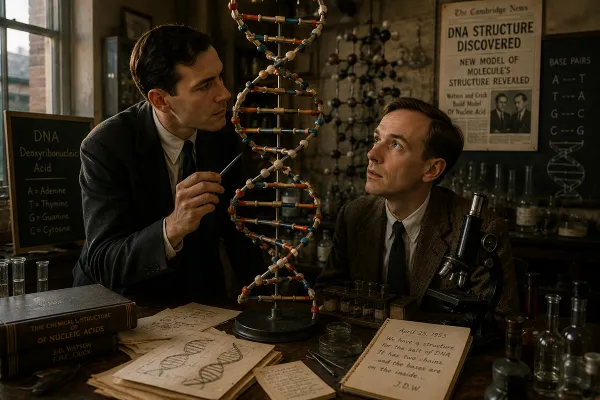
The DNA Double Helix: The Spiral That Spelled Life
In 1953, two young scientists pieced together a twisted ladder from scattered data and suddenly humanity could read the instruction book of every living thing.
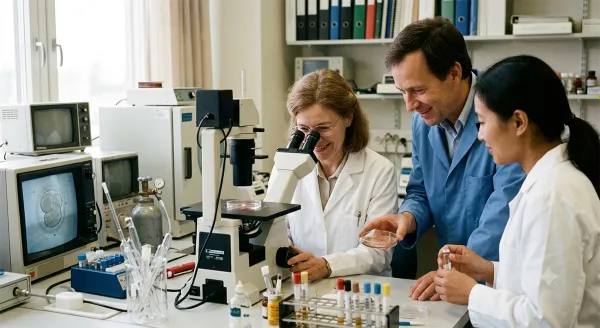
The Birth of IVF: Making Life Where Nature Couldn't
For decades, childless couples were told simply to accept it. Then two biologists learned to fertilize a human egg in a glass dish and opened a door millions walk through today.
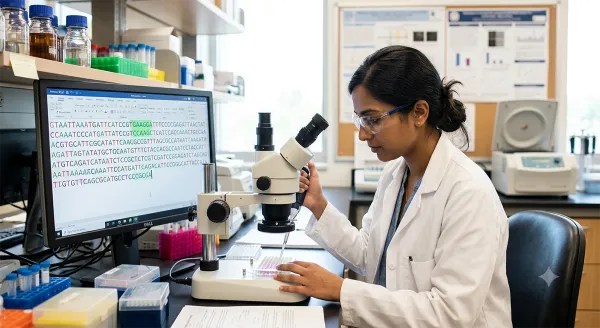
CRISPR Gene Editing: Life's Own Word Processor
A bacterial immune system, repurposed by scientists, became a find-and-replace tool for DNA. In 2012, we learned to edit the code of life itself.