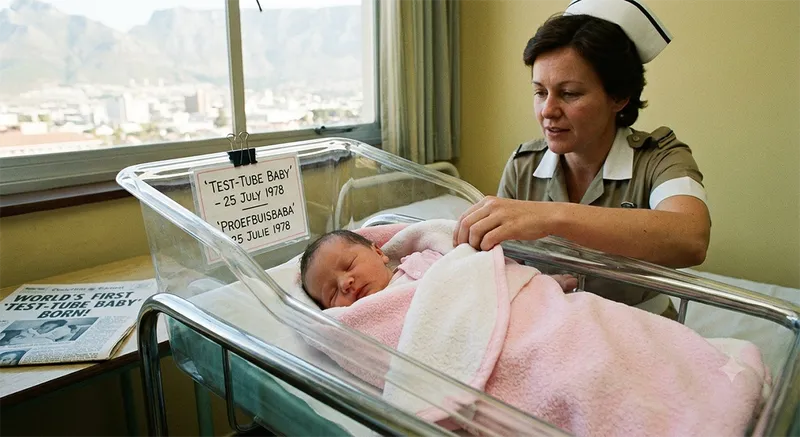
The First Test-Tube Baby: A New Life Begins in a Dish
On 25 July 1978, a baby girl was born who had been conceived not in a womb but in a glass dish. The world called her a 'test-tube baby' and a silent revolution began.
WOW Score
When Louise Brown was born in 1978, journalists dubbed her the first 'test-tube baby.' The reality was gentler: her parents' egg and sperm had met in a laboratory dish, then nestled into her mother's womb to grow like any child.
Her birth was the human face of IVF the proof that a revolution in conception could end in something utterly ordinary: a healthy, much-loved baby.
"She was conceived in a dish and born like any other child. In her ordinary cries, a million impossible hopes found a voice."
Louise Brown's birth proved IVF worked and legitimized fertility treatment worldwide. She became the first of over 8 million IVF children, transforming infertility from a private grief into a solvable medical condition.
The Full Story
A Mother's Blocked Tubes
Lesley Brown's fallopian tubes were blocked, making natural conception impossible. She and her husband John were referred to Patrick Steptoe and Robert Edwards, who were attempting the radical procedure of in-vitro fertilization. The Browns agreed to try what no one had achieved before.
Conception in a Dish
In November 1977, Steptoe retrieved one of Lesley's eggs laparoscopically and Edwards fertilized it with John's sperm in a nutrient solution. The resulting embryo was transferred to Lesley's uterus. For months the pregnancy proceeded in secrecy and anxiety, under intense media suspicion.
Born in Oldham
On 25 July 1978, Lesley delivered Louise by caesarean section in Oldham, England. The healthy 5-pound baby was front-page news across the globe. 'Test-tube baby' became the shorthand the world used inaccurate, but unforgettable for a child conceived outside the body.
An Ordinary Life
Louise grew up healthy and later had children of her own, naturally. She became a quiet symbol rather than a spectacle. Her birth reassured millions of infertile couples that hope was real, and showed that the fear surrounding IVF was largely unfounded.
The Door She Opened
Louise was the first; millions followed. Her birth converted IVF from a curiosity into a compassionate, world-changing therapy and set the stage for egg freezing, surrogacy, and the genetic technologies explored elsewhere in this series. One baby in a dish rewrote what a family could be.
Related Turning Moments
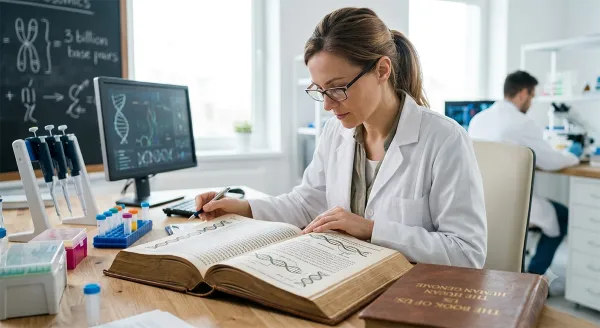
The Human Genome Project: Reading the Book of Us
It took 13 years, billions of dollars, and an international army of scientists to spell out the 3 billion letters of human DNA. In 2003, we finally read ourselves.
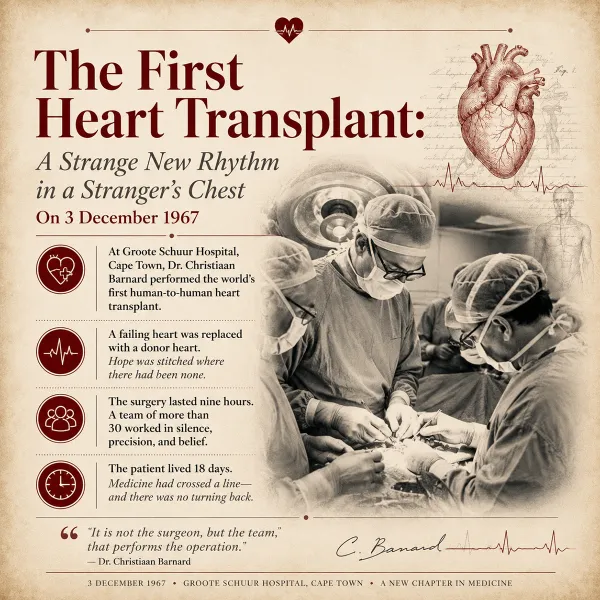
The First Heart Transplant: A Strange New Rhythm in a Stranger's Chest
On 3 December 1967, a surgeon in Cape Town moved a beating heart from one man's chest into another's. Medicine crossed a line it could never uncross.
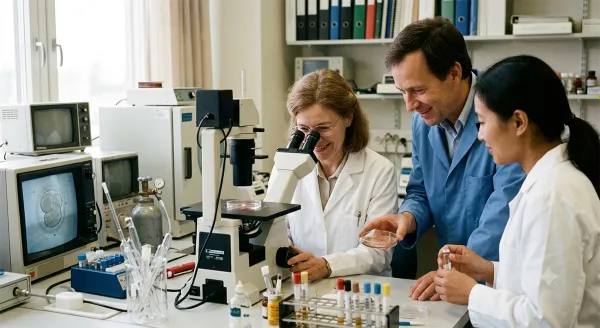
The Birth of IVF: Making Life Where Nature Couldn't
For decades, childless couples were told simply to accept it. Then two biologists learned to fertilize a human egg in a glass dish and opened a door millions walk through today.