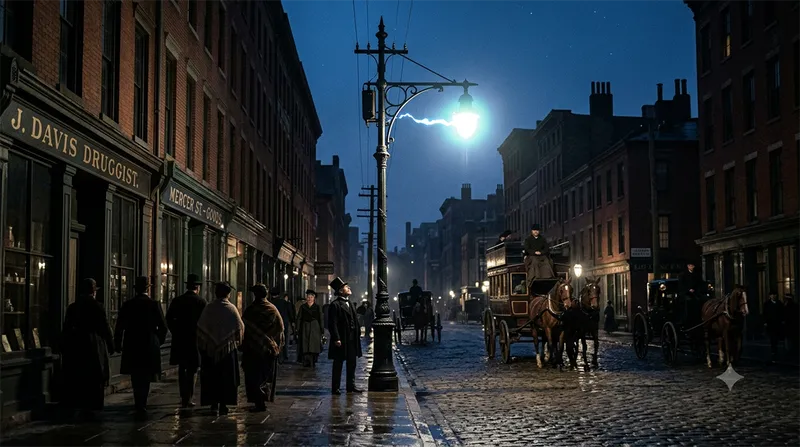
Electricity: The Invisible Force That Lit the World
It sparked in storms and tingled in amber for two thousand years. Then humans learned to make it flow on command and powered the modern age.
WOW Score
The Greeks noticed rubbed amber could attract bits of straw; Ben Franklin floated a kite into a thunderstorm; Faraday and Maxwell revealed that magnetism and electricity were two faces of one force.
Then came generators, grids, and the light bulb. For the first time, humans could summon light, heat, and motion from a wall cleanly, instantly, and at scale.
Electricity is the bloodstream of civilization: invisible, essential, and everywhere. Unplug it, and the world stops.
"Electricity is the only invention that makes almost every other invention possible. Cut the grid and the modern world goes dark in an instant."
Electricity became the universal medium of power and information. It lit cities, ran factories, carried telegraphs and telephones, and later powered computers and the internet. Nearly every technology of the last 150 years from refrigeration to AI rides on the controlled flow of electrons.
The Full Story
From Curiosity to Law
William Gilbert coined the word 'electric' in 1600. Over the next two centuries, scientists from Volta to Ampere to Ohm mapped how charge, current, and resistance behave. The theory was crowned by James Clerk Maxwell, whose equations (see the theory of relativity's deeper context) showed light itself is an electromagnetic wave.
Making It Flow
Michael Faraday's 1831 discovery of electromagnetic induction moving a magnet near a coil generates current made generators possible. Within decades, dynamos lit streets and factories. The age of mechanical power gave way to the age of electrical power.
The War of the Currents
Edison championed direct current (DC); Tesla and Westinghouse backed alternating current (AC), which could travel long distances efficiently. AC won, enabling continent-spanning grids. The outcome still hums through the wires in your wall.
Light, Then Everything
The incandescent bulb turned night into day and cities into 24-hour ecosystems. But electricity's bigger gift was versatility: it ran motors in every factory, carried the telegraph and telephone, and later became the substrate for electronics, computing, and the internet.
The Quiet Grid
Today a global web of generators, transformers, and cables delivers power on demand so reliable we only notice it when it fails. Electricity is the hidden prerequisite of modernity: the force that lets a single home hold more light and calculation than all the empires of the ancient world.
Related Turning Moments
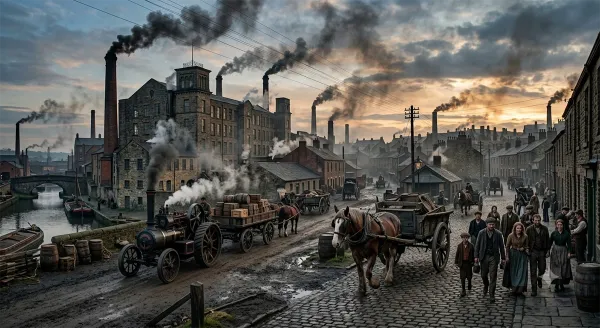
The Industrial Revolution: When Steam Replaced Muscle
In a single generation, humans stopped relying on the strength of their backs and started harnessing coal, iron, and machines. Nothing was ever the same.
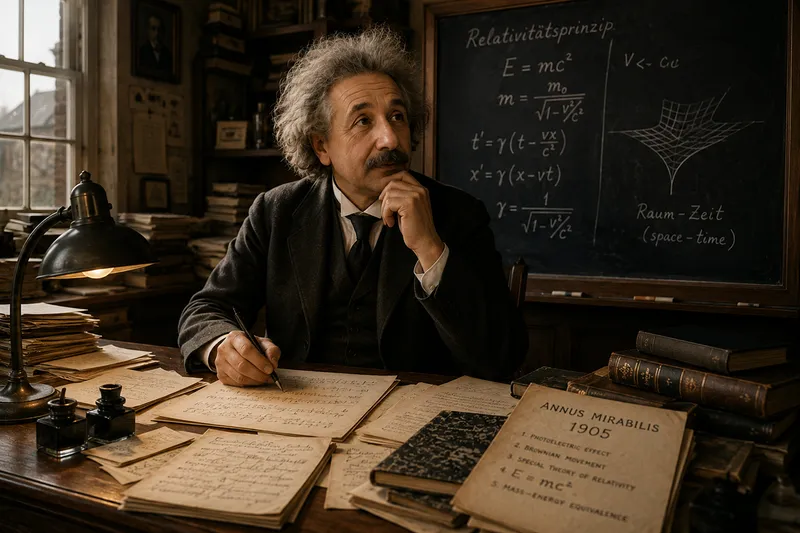
Einstein's Theory of Relativity: The Year a Clerk Rewrote Time
In 1905, a 26-year-old patent clerk with no university job published four papers that shattered Newton's universe. One of them said time itself is not absolute.
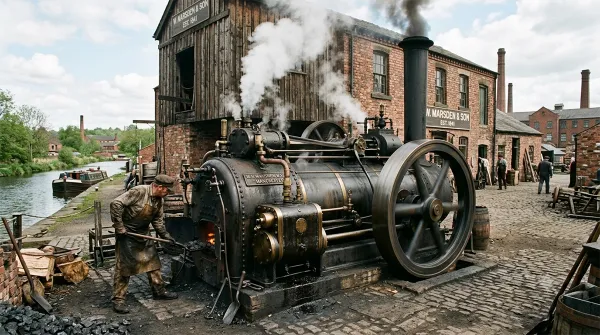
The Steam Engine: When Heat Learned to Do the Work
For millennia, power meant a back, a beast, or a breeze. Then a piston learned to drink boiling water and the modern world roared to life.