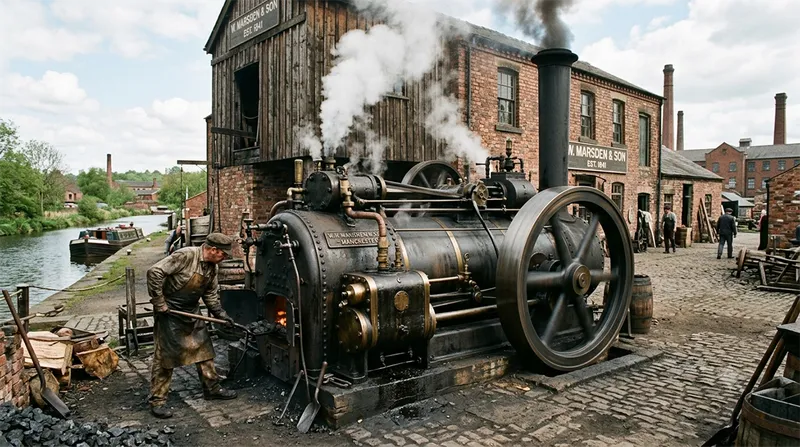
The Steam Engine: When Heat Learned to Do the Work
For millennia, power meant a back, a beast, or a breeze. Then a piston learned to drink boiling water and the modern world roared to life.
WOW Score
Thomas Newcomen built the first practical steam engine in 1712 to pump water from flooded mines. It was clumsy and thirsty for coal, but it proved a stunning idea: fire could be converted into motion.
James Watt's separate condenser, patented in 1769, made the engine efficient enough to power anything. Suddenly factories, mills, and locomotives had an engine that never tired.
The steam engine is the hinge between the old world and the new the moment human power stopped scaling with human bodies.
"The steam engine was the first machine that did not eat, sleep, or tire. Humanity had finally built a servant that ran on chemistry, not muscle."
The steam engine drained mines, powered factories, pulled trains, and drove ships across oceans. It made the Industrial Revolution possible, accelerated global trade, and began the fossil-fuel age unleashing both unprecedented prosperity and the carbon emissions that warm our planet today.
The Full Story
From Mine Pump to Prime Mover
Newcomen's atmospheric engine saved Britain's coal mines by keeping them dry, but it wasted most of its heat. Watt's great insight condensing steam in a separate chamber nearly doubled efficiency and turned a pump into a general-purpose engine. With his rotary motion, the engine could spin wheels, not just lift weights.
Power Anywhere
Before steam, industry clustered where water or wind was available. Steam freed factories to rise anywhere beside ports, in cities, near coalfields. Production exploded in scale and speed, and the factory system was born, pulling millions from farms into towns.
The Iron Road
Mounted on wheels, the steam engine became the locomotive. Railways shrank distances, unified markets, and moved armies and ideas at speeds no road or canal could match. By 1850 a journey of days took hours, and the modern sense of time and distance was rewritten.
Sailing Without Wind
Steamships broke the tyranny of trade winds and currents, making schedules reliable and oceans ordinary. Global commerce accelerated, empires tightened their grip, and mass migration crossed the seas. The world became, for the first time, a single connected system.
The Engine That Changed the Climate
The steam engine began humanity's vast burning of buried sunlight coal, then oil. It lifted billions into abundance, but also lit the fuse of climate change. Every engine since, from the car to the power plant, is its descendant. The piston that moved the piston moved history.
Turning Point Connections
How this moment set others in motion — and what set it in motion. Each node links to a related turning point; the label on the line is the cause-and-effect relationship.
Related Turning Moments
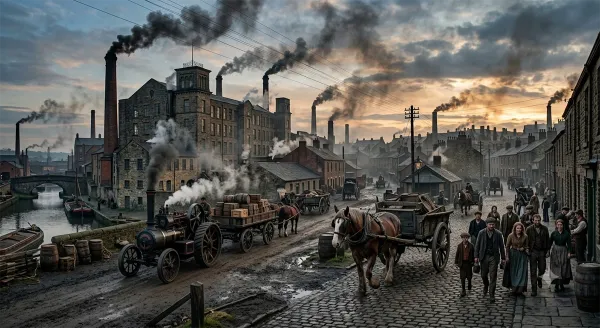
The Industrial Revolution: When Steam Replaced Muscle
In a single generation, humans stopped relying on the strength of their backs and started harnessing coal, iron, and machines. Nothing was ever the same.
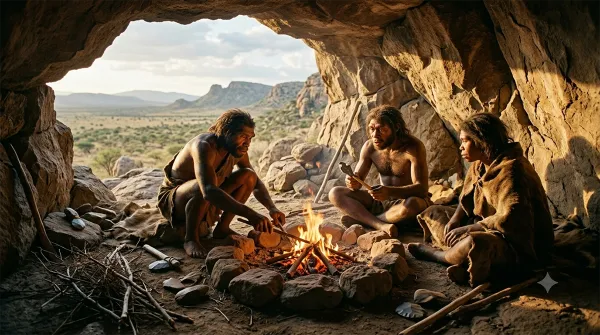
The Discovery of Fire: How Humans Tamed the Flame
Before cities, before farming, before language as we know it, one species learned to hold lightning in its hands. Everything changed.
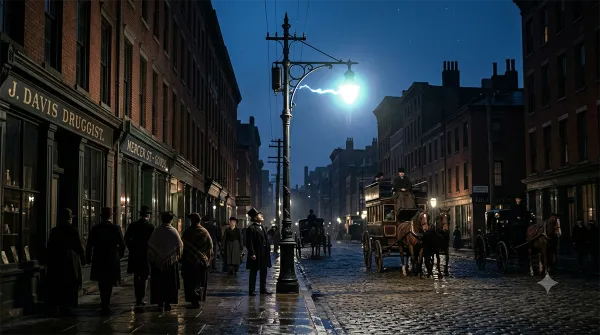
Electricity: The Invisible Force That Lit the World
It sparked in storms and tingled in amber for two thousand years. Then humans learned to make it flow on command and powered the modern age.