
Interstellar: When Hollywood Called a Nobel Laureate
November 2014. A blockbuster about love, time, and black holes was built with equations signed off by a real physicist.
- Director
- Christopher Nolan
- Writers
- Jonathan Nolan, Christopher Nolan
- Release Year
- 2014
- Genre
- Sci-Fi / Drama
- Main Cast
- Matthew McConaughey, Anne Hathaway, Jessica Chastain
- Runtime
- PT2H49M
WOW Score
Christopher Nolan brought in Kip Thorne, a Nobel-winning theoretical physicist, to ensure the science held up. The result bent both cinema and astrophysics.
The visual-effects team rendered Gargantua, the film's black hole, using Thorne's equations. The swirling halo you see on screen is what the math actually predicted.
Audiences left debating relativity, not just the plot a rare feat for a $165 million tentpole.
"The most talked-about image in the film the black hole was a scientific simulation, not a drawing."
Interstellar produced real astrophysics papers from its visual effects, advanced public understanding of gravitational time dilation and wormholes, and became a reference point for scientifically grounded science fiction. Its black-hole imagery is still used in classrooms.
Behind the Scenes
The Physicist in the Room
Thorne constrained every major visual to real physics, refusing fudges that broke the laws of the universe. When the effects team solved the light-bending equations, the resulting image revealed details nobody had visualized before and those findings were published in a scientific journal.
Time as a Feeling
The film's most emotional beat, a father aging while his children grow old, is grounded in genuine gravitational time dilation. Nolan used hard science to serve soft feeling, turning Einstein into the story's quiet engine.
Related Turning Moments

The Spinning Top: Cinema's Most Debated Final Shot
One final cut to black. No answer given. A decade of arguments started with a single spinning top.

Titanic: The Movie That Sank Expectations and Ruled the World
December 1997. A three-hour romance about a sinking ship was supposed to be a flop. Instead, it became the first film to earn a billion dollars.
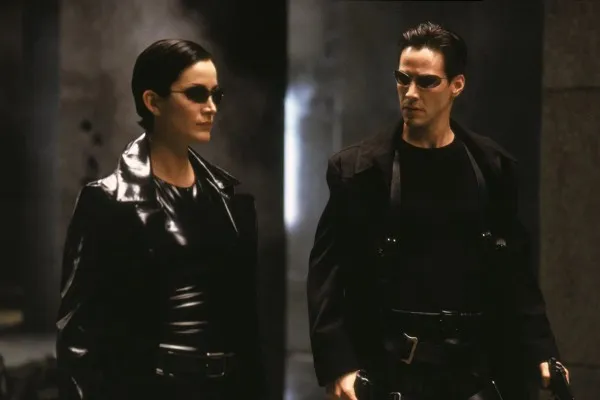
The Matrix: The Camera Move That Bent Reality
March 1999. A hallway fight froze time and spun the camera around a bullet and redefined what a movie could look like.