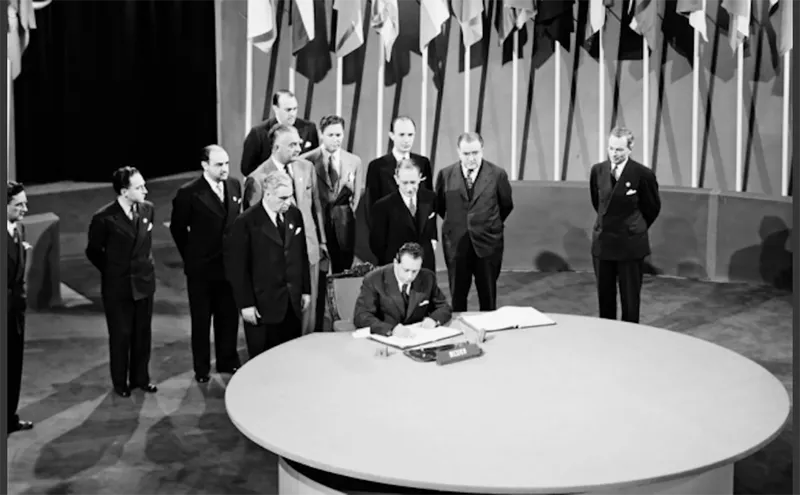
The Pact Signed in San Francisco
June 26, 1945. With World War II still smoldering in the Pacific, fifty nations gathered in San Francisco to write a charter nobody thought possible a decade earlier: a permanent league of the world.
WOW Score
The League of Nations had collapsed in the 1930s because the great powers would not enforce it, and the world slid into the deadliest war in history.
At Dumbarton Oaks and Yalta, the Allied leaders designed a new organization with real power vested in a Security Council of the victors, rather than the toothless equality of the old league.
On October 24, 1945, after enough nations ratified it, the UN Charter entered into force, and the United Nations was born.
"The first such league had failed and helped invite a second world war. This time, the victors built the institution before the peace was even signed."
The United Nations became the central forum for international law, peacekeeping, and humanitarian aid, shaping global life from decolonization to climate talks for the rest of the century.
The Full Story
The Failure That Preceded It
After World War I, the League of Nations was created to make war 'a thing of the past.' But the United States never joined, the Soviet Union was expelled, and members refused to confront aggressors in the 1930s. Its collapse taught a blunt lesson: a world body without the great powers' commitment is decoration, not defense.
Roosevelt's Four Policemen
President Franklin Roosevelt imagined the post-war order as a concert of the 'Four Policemen' (the US, UK, USSR, and China) who would keep the peace among the rest. That idea hardened into the UN Security Council, where those powers, plus France, hold permanent seats and veto power. It was a pragmatic compromise between idealism and the reality of who held the guns.
From Dumbarton Oaks to Yalta
In 1944, diplomats at Dumbarton Oaks in Washington sketched the structure: a General Assembly of all members and a powerful Security Council. At Yalta in early 1945, Roosevelt, Churchill, and Stalin agreed on the veto and the membership of the permanent five. The framework was set even as the war raged on.
San Francisco Conference
From April to June 1945, delegates from fifty nations met in San Francisco to negotiate the final Charter. Smaller states fought for a stronger General Assembly and a provision on non-self-governing territories. The result was a 111-article document balancing great-power authority with universal membership, signed on June 26 in the city's opera house.
The Veto and the Vision
The Charter's boldest and most contested feature was the great-power veto, which let any permanent member block Council action. Critics called it a license for inaction; its defenders argued it was the only way the major powers would join at all. Without it, they believed, there would be no United Nations, only another failed league.
Entering Into Force
The Charter required ratification by the five permanent members and a majority of the other signatories. China, France, the USSR, the UK, and the US deposited their ratifications, and on October 24, 1945, the United Nations officially came into being. That date is still marked as United Nations Day.
What the UN Became
Beyond the Security Council, the UN spun out institutions that touch daily life: the Universal Declaration of Human Rights (1948), UNICEF, the World Health Organization, peacekeeping forces, and agencies for refugees, food, and culture. It became the arena where colonies became states and where the language of human rights entered global law.
The Turning Moment
The world chose, amid the ruins of its second global catastrophe, to try internationalism one more time, but this time built around the winners' willingness to enforce it. The turning point was the decision that cooperation required accepting the great powers' dominance rather than pretending they were equal to the small.
Lasting Legacy
For all its frustrations and vetoes, the UN has prevented some wars, fed millions, and given every state a seat at the table. It is the nearest thing humanity has to a shared government, and its founding in 1945 remains the moment the international system we still live under was written into being.
Related Turning Moments
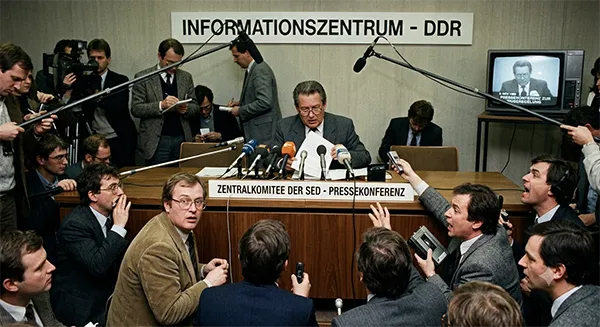
The Press Conference Mistake That Brought Down a Wall
November 9, 1989. An East German spokesman misread a note. Within hours, hammers were breaking through concrete that had divided a continent for 28 years.
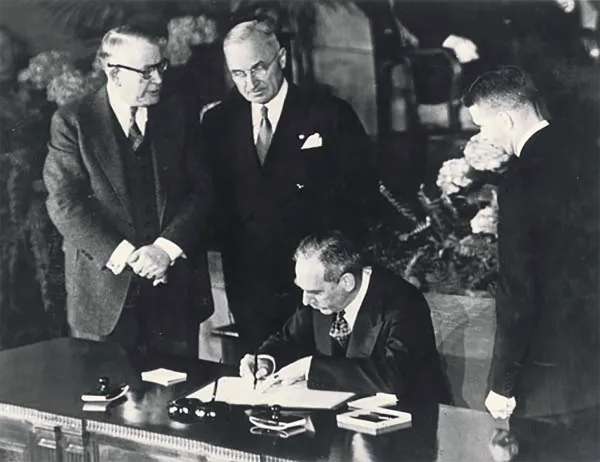
The Alliance That Froze the Front Line
April 4, 1949. Twelve nations signed a treaty in Washington promising that an attack on one would be an attack on all. For the first time, the Americas and Europe bound their defenses as one.
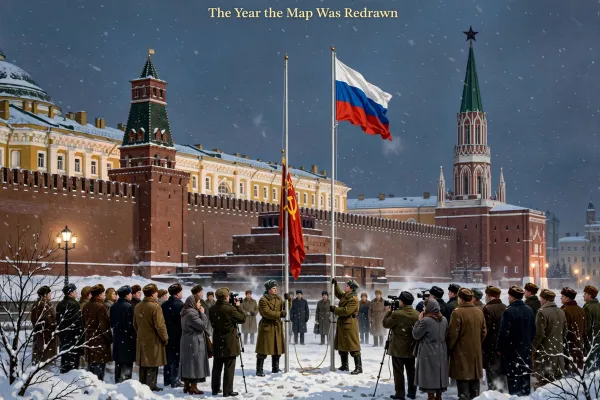
The Year the Map Was Redrawn
December 25, 1991. The red flag over the Kremlin came down for the last time. A superpower that had threatened the world with nuclear annihilation for forty years simply ceased to exist.