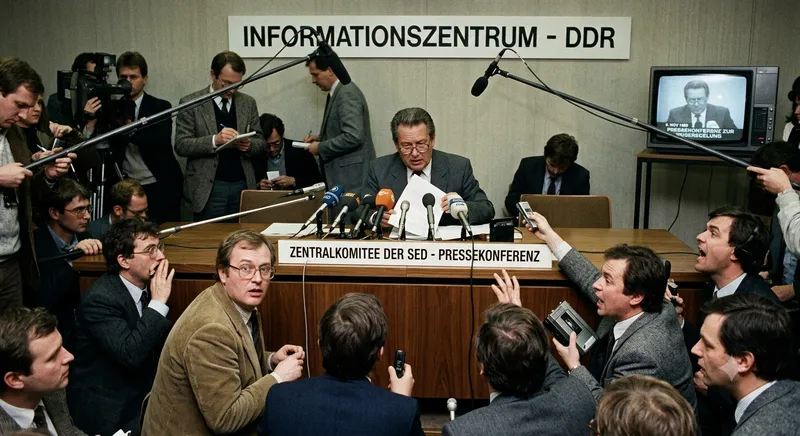
The Press Conference Mistake That Brought Down a Wall
November 9, 1989. An East German spokesman misread a note. Within hours, hammers were breaking through concrete that had divided a continent for 28 years.
WOW Score
East German spokesman Günter Schabowski was handed a note about relaxed travel restrictions minutes before a live press conference, with no time to review the details.
Asked when the new rules would take effect, he hesitated, shuffled his papers, and answered: 'As far as I know, immediately, without delay.' It was a guess the actual plan was for the next day, with controlled implementation.
Within hours, tens of thousands of East Berliners gathered at checkpoints. Overwhelmed guards, receiving no contrary orders, simply opened the gates. The wall that had defined a generation fell because of an unrehearsed answer to a single question.
"A single ambiguous sentence 'as far as I know, immediately' was all it took to end the Cold War's most visible symbol."
German reunification followed within a year. The Soviet Union itself would dissolve within 26 months. The fall reshaped the map of Europe, ended the Cold War order, and became the defining image of the 20th century's final decade.
The Full Story
Why the Wall Went Up
The Berlin Wall was built in 1961 not to keep people out, but to keep them in. After World War II, Germany was split and Berlin was divided inside Soviet-controlled East Germany, and by the late 1950s East Germany was hemorrhaging its youngest, best-educated citizens to the West through the open city. Overnight on August 13, 1961, East German troops strung up barbed wire and began pouring concrete, sealing 28 years of separation, fear, and death for those who tried to cross.
A System Under Strain
By 1989, the communist bloc was cracking. Mikhail Gorbachev's reforms in Moscow, glasnost and perestroika, loosened the old certainties, and across Eastern Europe reformers pushed open doors. In East Germany, mass demonstrations swelled week after week, and tens of thousands fled through the newly opened border with Hungary. The regime was losing control, but it had no plan to surrender the wall that was its defining symbol.
The Note He Never Read
The travel decree Schabowski read had been drafted earlier that day by a Politburo eager to appear responsive, not to open the border. It was meant to take effect the next morning with phased controls. No one told the spokesman, and no one told the border guards, who were left interpreting live television for their orders.
The Press Conference That Changed Everything
On the evening of November 9, Günter Schabowski, a Politburo member, fielded questions at a live, televised briefing. Handed the new travel rules with no time to study them, he was asked when they would apply. He shuffled his papers, hesitated, and said, 'As far as I know, immediately, without delay.' It was an off-the-cuff guess; the real plan was for the next day. But the cameras were rolling, and the words could not be recalled.
How a Guess Became History
When guards realized the world's cameras were watching and no counter-order arrived, they lifted the barriers rather than fire on their own citizens. The pressure of the crowd and the vacuum of command did what years of opposition had not. The wall did not fall by plan it fell by accident, met by mass courage.
The Hammers and the Headlines
Through the night, East and West Berliners climbed onto the wall, embraced strangers, and began chipping at the concrete with hammers, picks, and bare hands. Television beamed the scenes worldwide: champagne on the Wall, border guards with flowers in their rifle barrels, families reunited who had not touched in decades. The most heavily guarded frontier in Europe had become, in a single evening, a party.
Reunification and the End of an Era
The opening of the wall set off a chain reaction. Germany reunified less than a year later, on October 3, 1990, and the Soviet Union itself dissolved within 26 months. The Cold War order that had structured global politics for two generations collapsed, and the map of Europe was redrawn. What began as a spokesman's slip became the hinge of modern history.
The Turning Moment
Everything turned on one unrehearsed sentence in a crowded room. Not a treaty, not a battle, not a vote, but a hesitant guess answered to a reporter's question, broadcast live, and believed by a city. The wall that had stood for 28 years came down because no one in authority corrected the mistake in time, and a population that had waited for permission finally stopped waiting.
Lasting Legacy
The fall of the Berlin Wall endures as the defining image of the 20th century's final decade and the universal symbol of freedom won by accident and courage. It reshaped Europe, hastened the end of the Soviet Union, and gave the world a word for sudden liberation. Whether remembered as the moment the Cold War ended or simply the night a city chose not to be divided, one fact is already clear: November 9, 1989, is when a wall built to last forever lasted a single evening.
Related Turning Moments
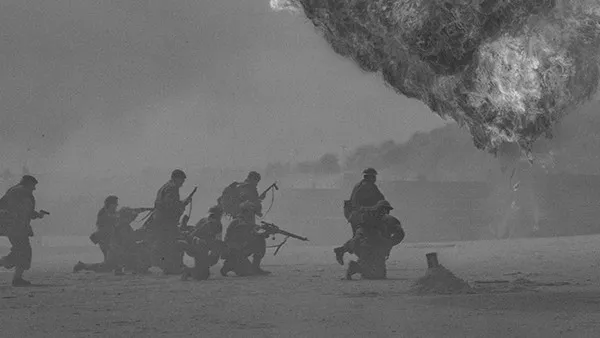
D-Day: The 24 Hours That Decided WWII
At 6:30 AM on June 6, 1944, the world held its breath as 156,000 Allied troops stormed five beaches into the unknown.
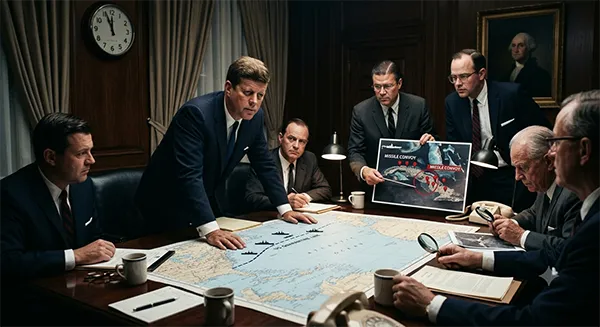
13 Days: The Message That Stopped a Nuclear War
October 1962. Two letters arrived from Moscow. One threatened war. One offered peace. Kennedy chose which one to answer.