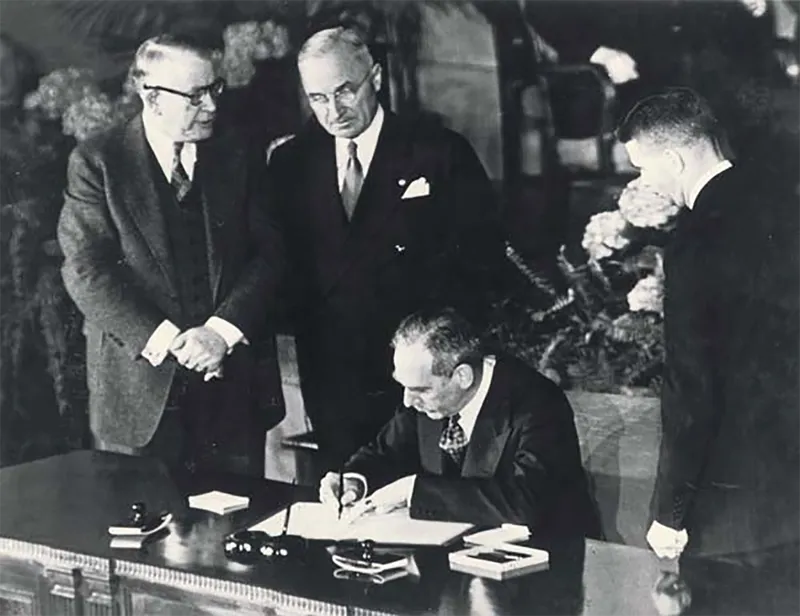
The Alliance That Froze the Front Line
April 4, 1949. Twelve nations signed a treaty in Washington promising that an attack on one would be an attack on all. For the first time, the Americas and Europe bound their defenses as one.
WOW Score
The Soviet blockade of Berlin in 1948 showed that the postwar peace was fragile and that the United States could no longer retreat across the Atlantic as it had after 1918.
Diplomats drafted a treaty grounded in Article 5: an armed attack against one member in Europe or North America would be met as an attack against them all, backed by the American nuclear umbrella.
Signed by twelve founding states, NATO turned a loose set of anxious nations into a single defensive bloc, and the dividing line of the Cold War snapped into place.
"Article 5 had never been tested when it was written. It would become the most consequential promise in modern alliance history."
NATO cemented the Western bloc, deterred Soviet expansion in Europe, and anchoring American power on the continent for generations. It set the structure of the Cold War and outlived it.
The Full Story
From Wartime Allies to Rivals
During World War II, the US, Britain, and Soviet Union were uneasy partners against Hitler. By 1947, the alliance had dissolved into suspicion as Stalin tightened his grip on Eastern Europe. The Truman Doctrine and the Marshall Plan committed America to containing Soviet power, but Europe needed a hard security guarantee to feel safe.
The Shock of the Berlin Blockade
In 1948, the Soviets cut off road and rail access to West Berlin, betting the West would abandon the city. Instead, the Allies mounted a year-long airlift that supplied two million people by plane. The blockade convinced Western leaders that only a formal, armed alliance with the United States could prevent further Soviet pressure.
Writing the Treaty
Negotiations in Washington produced a short, deliberate document. Its heart was Article 5, which treated an attack on any member as an attack on all, to be answered with 'such action as it deems necessary, including the use of armed force.' The language was collective but left each nation its own judgment, a careful blend of commitment and sovereignty.
Twelve Founders
The original members were the United States, Canada, Britain, France, Italy, the Netherlands, Belgium, Luxembourg, Portugal, Denmark, Norway, and Iceland. They spanned the North Atlantic, hence the name. Greece and Turkey joined in 1952, and West Germany in 1955, each expansion drawing the Iron Curtain a little firmer.
The Soviet Response
In 1955, the USSR formed the Warsaw Pact, binding its Eastern European satellites into a mirror-image alliance. Europe was now organized into two armed camps facing each other across a static line from the Baltic to the Balkans. The Cold War had acquired its permanent architecture.
Why It Held
NATO's durability came from the American guarantee. Knowing Washington would treat an attack on Paris or Bonn as an attack on New York deterred Soviet adventurism in the West. The alliance also gave smaller states a voice and a shield, turning a continent of rival powers into a relatively stable bloc.
Article 5's First Test
For decades Article 5 was a paper promise. That changed on September 12, 2001, after the attacks on the United States, when NATO declared for the first time that the treaty applied. It was invoked not in Europe but in response to terrorism, proving the alliance could adapt beyond its original Cold War purpose.
The Turning Moment
The signing marked the moment the United States accepted a permanent role in European security, abandoning its traditional isolationism. The turning point was not a battle but a signature that told Moscow the Western front would not shift, and told Europe it would not stand alone.
Lasting Legacy
NATO kept the peace in Europe for seventy years without a major war between its members, and after the Cold War it expanded eastward, taking in former Warsaw Pact states. Its founding in 1949 remains the cornerstone of the transatlantic order and the clearest line drawn at the start of the Cold War.
Related Turning Moments
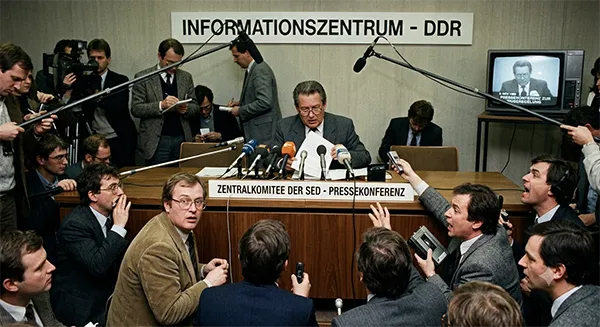
The Press Conference Mistake That Brought Down a Wall
November 9, 1989. An East German spokesman misread a note. Within hours, hammers were breaking through concrete that had divided a continent for 28 years.
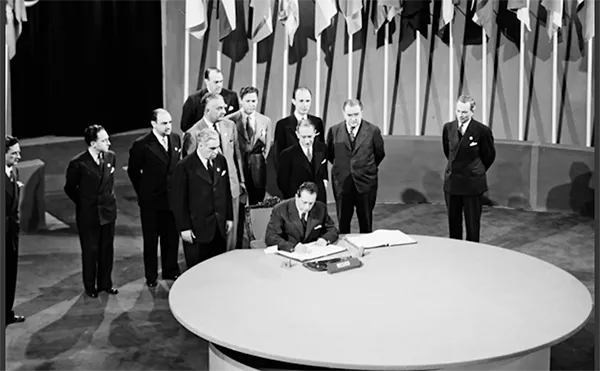
The Pact Signed in San Francisco
June 26, 1945. With World War II still smoldering in the Pacific, fifty nations gathered in San Francisco to write a charter nobody thought possible a decade earlier: a permanent league of the world.
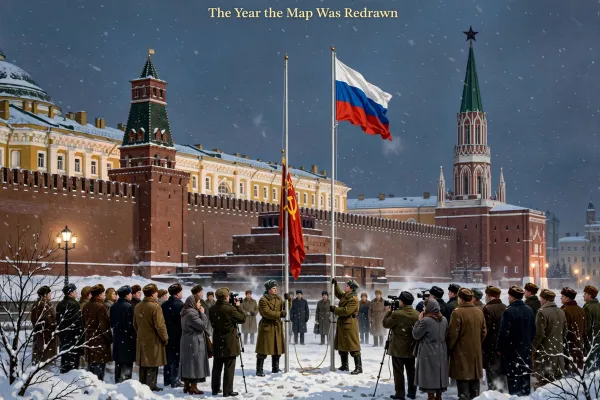
The Year the Map Was Redrawn
December 25, 1991. The red flag over the Kremlin came down for the last time. A superpower that had threatened the world with nuclear annihilation for forty years simply ceased to exist.