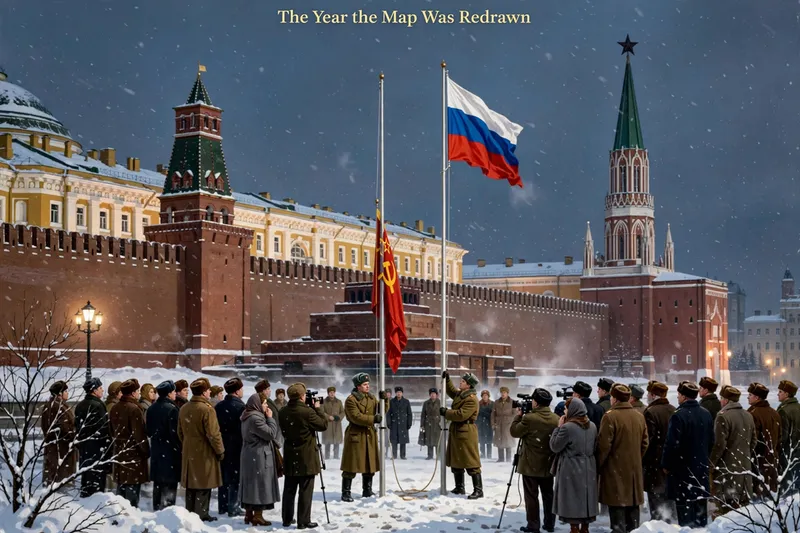
The Year the Map Was Redrawn
December 25, 1991. The red flag over the Kremlin came down for the last time. A superpower that had threatened the world with nuclear annihilation for forty years simply ceased to exist.
WOW Score
Mikhail Gorbachev came to power in 1985 promising reform, glasnost and perestroika, never imagining he would preside over the empire's dissolution.
His loosening of control unleashed forces he could not contain: independence movements in the republics, mass protests across Eastern Europe, and a failed hardline coup in August 1991 that broke the Communist Party's grip for good.
On Christmas Day, Gorbachev resigned, the Soviet Union was formally dissolved, and fifteen new countries blinked into existence on the world map.
"No world war was fought to end it. The Cold War died of exhaustion, reform, and the refusal of ordinary people to be afraid any longer."
The Soviet collapse ended the bipolar world, freed Eastern Europe, triggered nuclear-armed states emerging from the USSR, and left the United States as the sole superpower, reshaping global order overnight.
The Full Story
A System Running on Empty
By the 1980s, the Soviet Union was a giant with failing lungs: a stagnant economy, an unwinnable war in Afghanistan, and a population that no longer believed the official story. When Gorbachev took charge, he inherited a system that could neither reform fast enough nor repress as it once had.
Glasnost and Perestroika
Gorbachev's twin policies, openness and restructuring, were meant to save socialism by making it work. Instead, openness let long-suppressed grievances surface, and restructuring removed the centralized controls that had held the union together. He had hoped to renew the system; he ended up dismantling it.
1989: The Year of Revolutions
Across Eastern Europe, the satellite regimes crumbled almost without bloodshed. Poland's Solidarity won free elections, Hungary opened its border, the Berlin Wall fell in November, and the Velvet Revolution swept Czechoslovakia. The Iron Curtain, defended by tanks for decades, simply dissolved as Moscow declined to send them.
The Coup That Doomed the Party
In August 1991, hardliners placed Gorbachev under house arrest and tried to seize control. Russians poured into the streets of Moscow to defend the Russian Federation's defiant president, Boris Yeltsin, who stood on a tank and called the coup illegal. The plot collapsed in days, but the Communist Party never recovered its authority.
Republics Slip Away
With the center paralyzed, the union's fifteen republics moved toward independence. Ukraine, the second-largest and most populous, voted overwhelmingly to leave in a December referendum. Without Ukraine, the Soviet Union was no longer viable, and the other republics followed.
The Last Red Flag
On the night of December 25, 1991, Gorbachev gave a televised resignation, handing control of the nuclear codes to Yeltsin. At 7:32 p.m., the Soviet red flag was lowered over the Kremlin and replaced by the Russian tricolor. The state that had launched the space age and built the largest nuclear arsenal on earth was gone.
A World Reordered
The United States emerged as the sole superpower, and a 'unipolar moment' of American dominance began. NATO and the EU expanded eastward. But the birth of fifteen states, several with Soviet nuclear weapons on their soil, also created new instabilities, from frozen conflicts to the slow estrangement of Russia from the West.
The Turning Moment
The Cold War ended not with a battle but with a resignation and a flag. The hinge of history was a leader who chose not to spill blood to save his power, and millions of citizens who chose, finally, not to be ruled by fear. The world changed because no one was willing to die for the old order.
Lasting Legacy
The Soviet collapse redrew the map of Eurasia and ended the nuclear standoff that had shadowed two generations. It opened Eastern Europe to democracy and markets, even as it left Russia grappling with loss and resentment. December 1991 remains the clearest line between the twentieth century's longest conflict and the uncertain world that followed.
Related Turning Moments
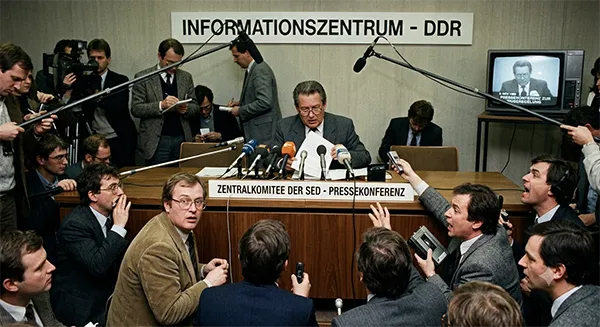
The Press Conference Mistake That Brought Down a Wall
November 9, 1989. An East German spokesman misread a note. Within hours, hammers were breaking through concrete that had divided a continent for 28 years.
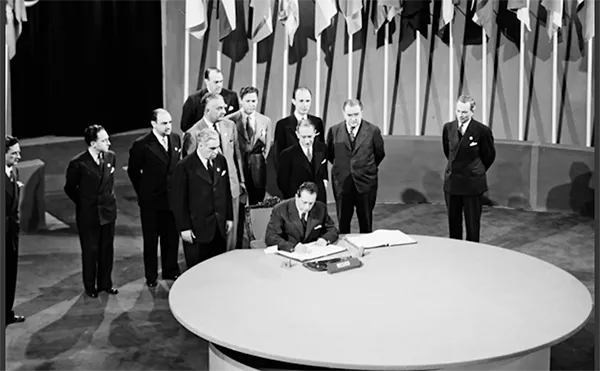
The Pact Signed in San Francisco
June 26, 1945. With World War II still smoldering in the Pacific, fifty nations gathered in San Francisco to write a charter nobody thought possible a decade earlier: a permanent league of the world.
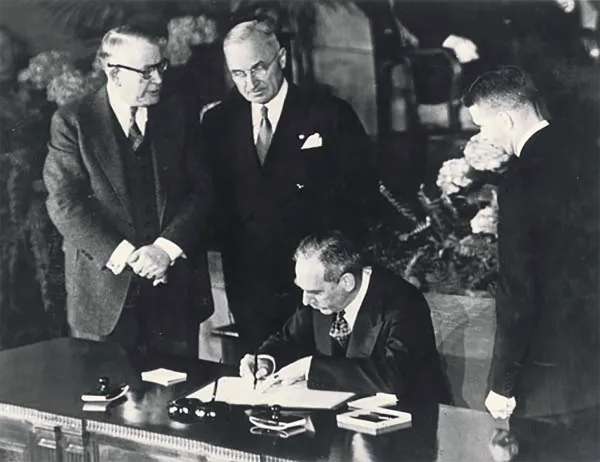
The Alliance That Froze the Front Line
April 4, 1949. Twelve nations signed a treaty in Washington promising that an attack on one would be an attack on all. For the first time, the Americas and Europe bound their defenses as one.