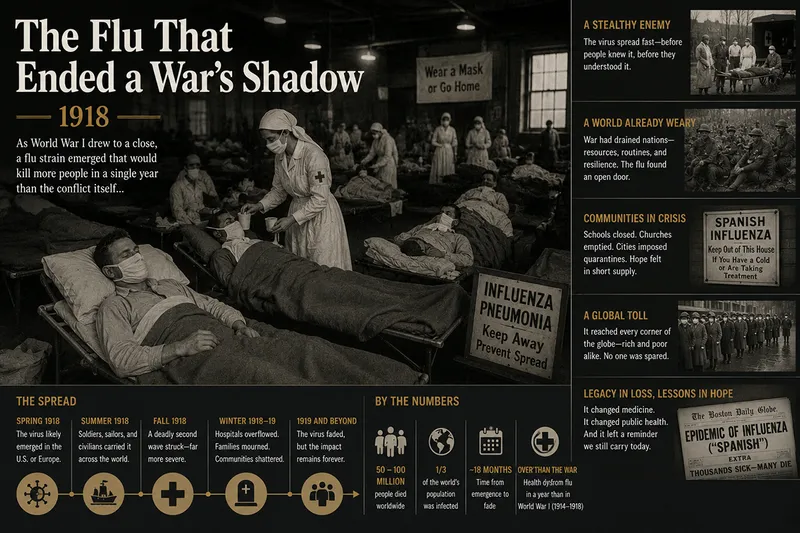
The Flu That Ended a War's Shadow
1918. As World War I drew to a close, a flu strain emerged that would kill more people in a single year than the conflict itself, and it preyed on the young and healthy most of all.
WOW Score
The first wave in spring 1918 was mild, but a mutated second wave that autumn struck with ferocious lethality, often killing within a day of the first symptom.
Wartime censorship suppressed news of the disease in belligerent nations, while neutral Spain reported openly, giving the pandemic its misleading name.
Cities banned gatherings, masked their populations, and shut schools, yet the virus crossed oceans with the troops and migrants of a mobilized world.
"Healthy soldiers dropped dead within hours. The pandemic circled the globe in months and silenced cities faster than any army could."
The 1918 influenza infected a third of humanity and killed tens of millions, shaping modern public health, mass vaccination, and the way nations respond to pandemics a century later.
The Full Story
Born in the Trenches' Shadow
The virus likely first appeared in the cramped, stressed conditions of troops and wartime movement in 1918. Mass armies, disrupted supplies, and global troop transports created the perfect engine for a respiratory disease to spread across continents.
The Deadly Second Wave
The autumn wave was a different beast: it killed not the usual weak but young adults in their twenties and thirties, often through a runaway immune response that flooded the lungs. Victims could go from well to dead in hours, their skin turning a telltale blue from lack of oxygen.
Why 'Spanish'?
wartime governments in Britain, France, Germany, and the US suppressed reports to protect morale. Spain, neutral and uncensored, published frank accounts, so the world blamed Spain. The name stuck, a reminder of how silence shapes the memory of a catastrophe.
Cities in Masks
Authorities closed theaters, churches, and schools and mandated face coverings in public, echoing measures a century later. In some places, police fined the unmasked; in others, parades and rallies were banned even as the war wound down. Daily life was reordered by an invisible enemy.
A Global Toll
Estimates of deaths range from 20 to 50 million, possibly higher, more than the battle deaths of the Great War. It reached remote islands and Arctic villages alike, a truly planetary event in an age that thought itself less connected than ours.
Medicine Powerless
With no vaccines and no antibiotics for the secondary bacterial pneumonia that often finished victims, doctors could only isolate and support. The helplessness of science against the virus was a defining trauma of the era.
The Birth of Public Health
In the pandemic's wake, nations built permanent health ministries and international surveillance, seeds of today's disease-monitoring systems. The lessons, though partly forgotten by 2020, shaped a century of epidemic response.
The Turning Moment
The turning point was the autumn mutation that turned a nuisance into a killer of the young. A world exhausted by war found the peace it had won shadowed by a microbe that respected no armistice and no border.
Lasting Legacy
The 1918 influenza remains the benchmark for pandemics, the event against which all later outbreaks are measured. It proved how swiftly a virus can outrun human response and why preparedness, not panic, is the only real defense.
Related Turning Moments
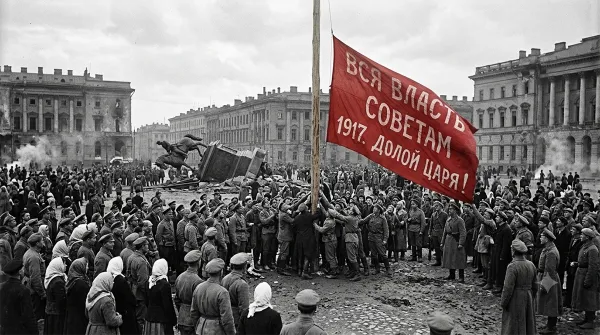
1917: The Year the Tsar Fell and the World Turned Red
In eight months a empire collapsed, a provisional government rose and fell, and Lenin's Bolsheviks seized history by the throat.
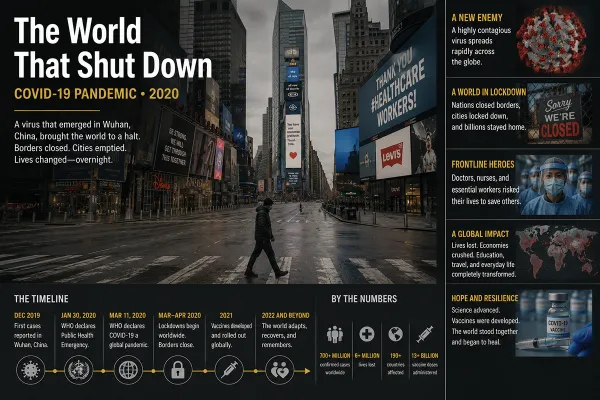
The World That Shut Down
Early 2020. A novel coronavirus spread from a Chinese city and, within weeks, emptied the streets of every major country on Earth. Modern life paused all at once.
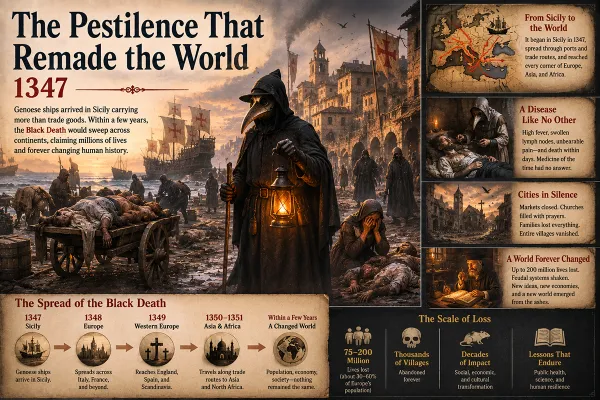
The Pestilence That Remade the World
1347. Genoese ships arrived in Sicily carrying more than trade goods. Within a few years, a bubonic plague had killed perhaps half of Europe's population and ended the world as the Middle Ages knew it.