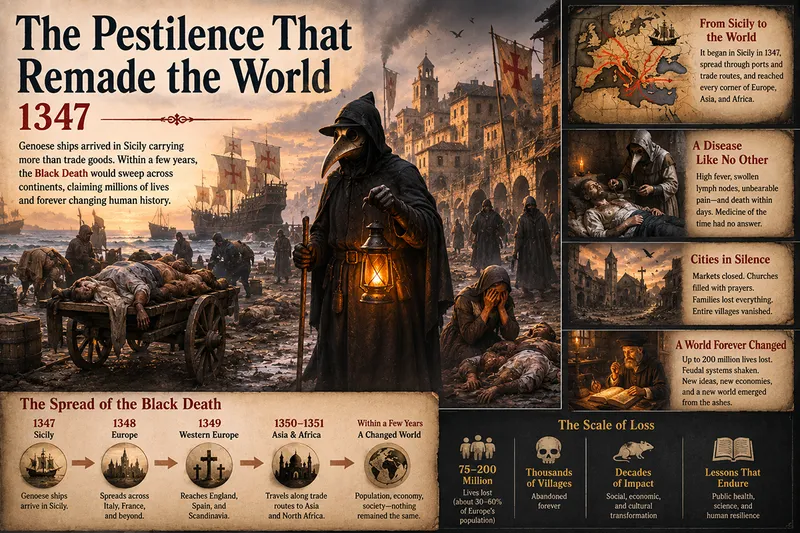
The Pestilence That Remade the World
1347. Genoese ships arrived in Sicily carrying more than trade goods. Within a few years, a bubonic plague had killed perhaps half of Europe's population and ended the world as the Middle Ages knew it.
WOW Score
The plague, carried by fleas on black rats aboard merchant ships, spread along the trade routes from the Crimea across the Mediterranean and into Europe.
Victims swelled with agonizing buboes, raved with fever, and often died within days; whole villages emptied, and the living were sometimes too few to bury the dead.
When it receded, perhaps 25 to 50 million Europeans had perished, and the social order that had seemed eternal was gone.
"So many died that survivors ran out of places to bury them, and the value of a human life, and of labor, was rewritten forever."
The Black Death shattered feudalism by making workers scarce and powerful, upended the Church's authority, and accelerated the economic and cultural shifts that ended the medieval order.
The Full Story
A Disease on the Silk Road
The plague likely originated in Central Asia and traveled with armies and caravans. In 1346 it struck a Genoese trading post at Caffa in the Crimea; according to some accounts, besieging Mongols catapulted infected corpses over the walls, an early instance of biological warfare that spread the disease onward.
The Ships Arrive
In October 1347, Genoese galleys reached Messina in Sicily, their crews already dying. The pathogen, Yersinia pestis, rode in the fleas of shipboard rats. From Mediterranean ports it fanned out along trade and pilgrimage routes into the heart of the continent.
Death at Speed
Contemporary chroniclers described a swift, merciless sickness: fever, vomiting of blood, and the swollen buboes that gave the disease its name. Mortality was terrifyingly high, and the speed of transmission outpaced any understanding of cause or cure.
A Society Unmade
Labor became scarce and therefore valuable. Surviving peasants and artisans could demand wages and leave the land, eroding the bonds of serfdom that had defined medieval life. The plague struck the foundations of feudalism with more force than any revolt.
The Church Shaken
Clergy died in disproportionate numbers tending the sick, and prayer proved no shield. As the institution failed to explain or stop the catastrophe, confidence in the Church weakened, feeding later dissent and the reforms that would fracture Christendom.
Scapegoats and Violence
In the face of incomprehensible death, communities sought culprits. Persecutions of Jews, beggars, and outsiders flared across Europe, a dark companion to the plague that revealed how fear turns catastrophe into cruelty.
A New Economy
With land abundant and workers few, wages rose and a commercial, more mobile society emerged. The Black Death, paradoxically, helped lay the groundwork for the Renaissance by loosening the rigid structures of the medieval world.
The Turning Moment
The turning point was demographic: when death removed so many that the relationship between people and power inverted. A disease became the engine of social revolution, ending an order that had stood for centuries not by conquest but by emptiness.
Lasting Legacy
The Black Death was the largest mortality event in human history, reshaping Europe's population, economy, and faith. It closed the Middle Ages and opened the early modern world, a reminder that catastrophe can be as transformative as any war.
Related Turning Moments
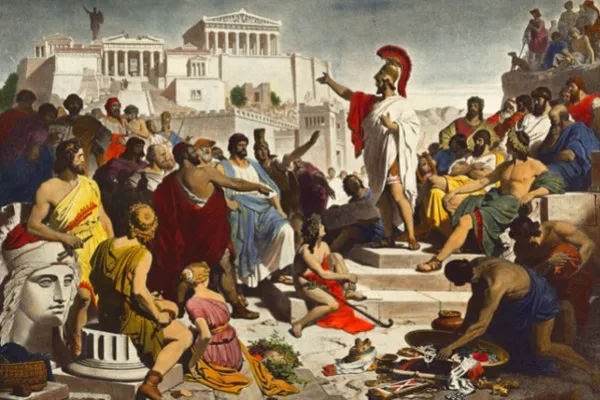
The Birth of Democracy in Athens
508 BCE. A clever reformer named Cleisthenes restructured Athens not by birth or wealth, but by where people lived. The word 'democracy' was about to be invented.
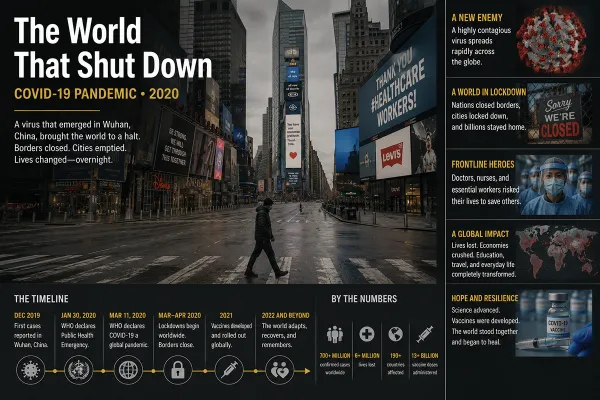
The World That Shut Down
Early 2020. A novel coronavirus spread from a Chinese city and, within weeks, emptied the streets of every major country on Earth. Modern life paused all at once.
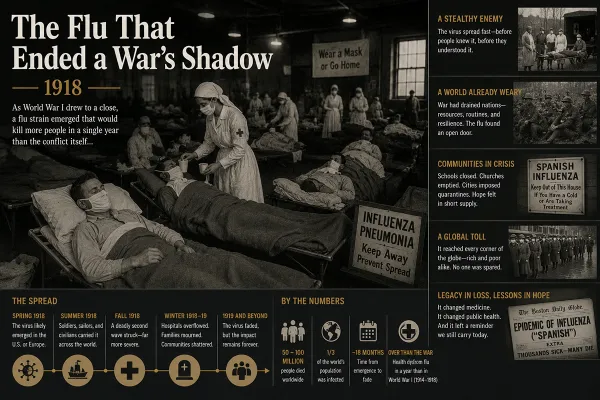
The Flu That Ended a War's Shadow
1918. As World War I drew to a close, a flu strain emerged that would kill more people in a single year than the conflict itself, and it preyed on the young and healthy most of all.