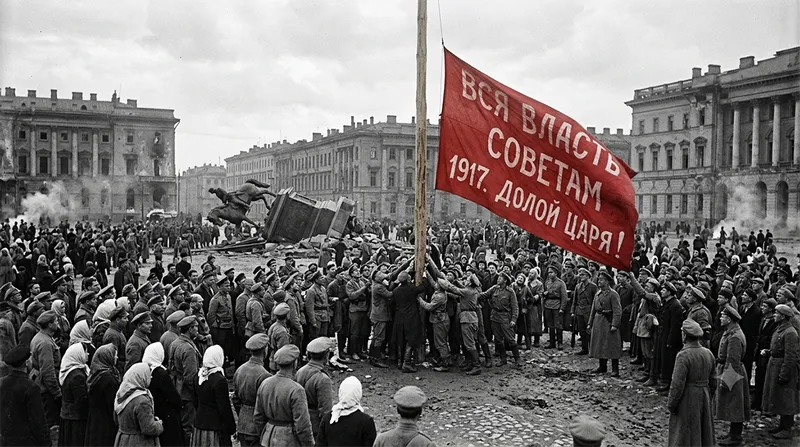
1917: The Year the Tsar Fell and the World Turned Red
In eight months a empire collapsed, a provisional government rose and fell, and Lenin's Bolsheviks seized history by the throat.
WOW Score
Russia in 1917 was starving, bleeding in World War I, and ruled by a mystic's favorite at the court of a weak tsar. In February, the people of Petrograd simply stopped obeying.
By October, a disciplined party of revolutionaries led by Vladimir Lenin stormed the Winter Palace and announced that power now belonged to the soviets.
The tsar was gone, the old order was ashes, and the most radical experiment in modern statecraft had begun.
"Bread, peace, and land three words that toppled a 300-year dynasty in a single winter."
The Russian Revolution ended the Romanov dynasty, pulled Russia out of World War I, and created the world's first socialist state. It triggered a civil war, redrew borders across Eurasia, and launched a 70-year ideological struggle with the West that defined the twentieth century's Cold War.
The Full Story
A Dynasty on the Edge
Centuries of Romanov rule ended not with a bang but with bread queues. Defeat after defeat on the Eastern Front, rampant inflation, and the influence of the mystic Rasputin over Tsarina Alexandra had gutted the monarchy's legitimacy. When protesters flooded the streets of Petrograd in February 1917, the army refused to fire, and Nicholas II abdicated the first time in modern history a major European empire simply dissolved from within.
The Dual Power
A Provisional Government took formal power, but it shared the stage with the Petrograd Soviet, a council of workers' and soldiers' deputies. That 'dual power' was unstable from the start. The government refused to end the war or redistribute land, while the soviets commanded the loyalty of the soldiers and factory workers. Into this vacuum stepped the Bolsheviks, a radical faction preaching that the revolution had only begun.
Lenin Returns
In April 1917, Germany shipped Lenin back to Russia in a sealed train, hoping his agitation would knock Russia out of the war. Lenin responded with his April Theses: no support for the Provisional Government, all power to the soviets, and immediate peace. The slogans 'Peace, Land, and Bread' and 'All Power to the Soviets' translated Bolshevik theory into demands ordinary Russians could feel in their stomachs.
The July Days and the Kornilov Affair
A failed spontaneous uprising in July forced the Bolsheviks underground, but a clumsy attempt by General Kornilov to march on Petrograd in August backfired. The government had to arm the workers to defend the city, and those same Red Guards now trusted the Bolsheviks as their protectors. By autumn, Bolshevik support in the soviets had swelled, and Lenin began planning a seizure of power.
The Storming of the Winter Palace
On the night of October 25, Bolshevik forces took the bridges, the post office, and the telegraph without firing a shot, then shelled and stormed the Winter Palace, where the Provisional Government sat. The cruiser Aurora fired a blank round as a signal. By morning, Lenin declared a proletarian government formed almost bloodlessly in the capital, though far bloodier struggles lay ahead.
The World Turned Red
The new regime signed a punitive peace with Germany, nationalized land and industry, and ignited a brutal civil war that killed millions. Out of the ashes rose the Soviet Union, a state built to export revolution worldwide. For the rest of the century, 1917 stood as the hinge between the old empires and the ideological superpower confrontation of the Cold War proof that a determined minority could seize the levers of a collapsing state.
Related Turning Moments
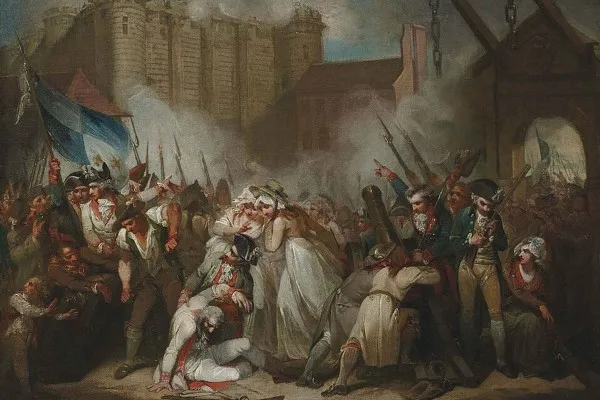
The Bastille: The Prison That Launched a Revolution
July 14, 1789. A Parisian mob stormed a medieval fortress looking for gunpowder and accidentally ignited the modern age.

The Shot Heard Round the World: How Thirteen Colonies Beat an Empire
April 19, 1775. A ragtag militia faced the world's strongest army on a Massachusetts green and a rebellion that would birth a superpower began.
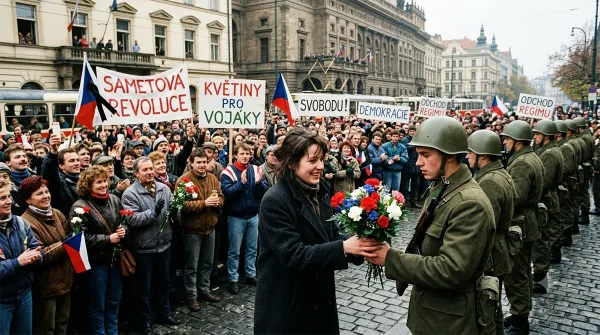
The Velvet Revolution: How Czechoslovakia Beat a Regime With Flowers
In 1989, a police baton charge against student protesters backfired so completely that a communist state dissolved without a shot.