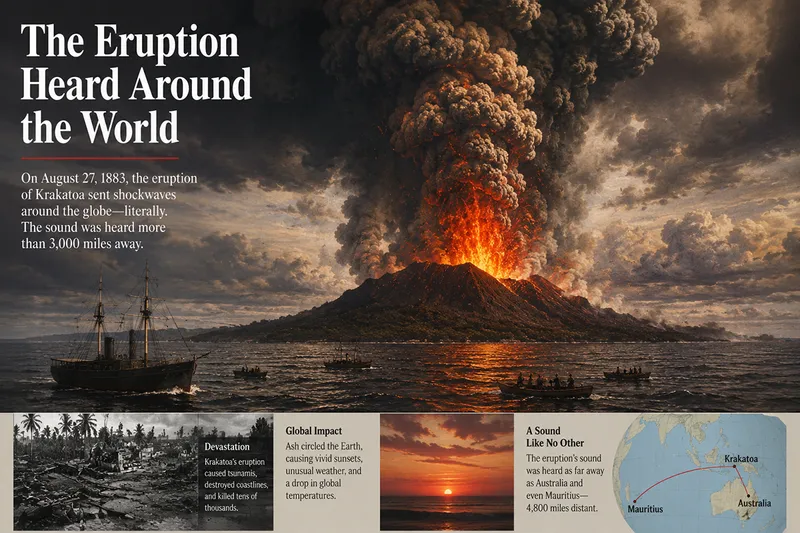
The Eruption Heard Around the World
August 27, 1883. A small island volcano between Java and Sumatra detonated with a blast heard 3,000 miles away, and the sea rose to swallow hundreds of villages.
WOW Score
Krakatoa had been rumbling for months, sending ash and steam skyward while nearby villagers dismissed the spectacle as a curiosity.
On the morning of August 27, a series of massive explosions reached a peak so violent it ruptured the island and sent tsunamis racing across the Sunda Strait at the speed of a jet.
The pressure wave circled the globe seven times, and the volcanic dust dimmed skies worldwide, painting sunsets red for three years.
"The final explosion was the loudest sound in recorded history, audible in Sri Lanka and Australia, and it triggered tsunamis 40 meters high."
Krakatoa killed over 36,000 people, reshaped global weather and sunsets for years, and became the template for understanding volcanic tsunamis and the planetary reach of a single eruption.
The Full Story
The Prelude
In May 1883, Krakatoa began erupting with spectacular plumes that drew sightseers by boat. Authorities noted the activity but saw no reason to evacuate the sparsely populated island or the coastlines across the strait, a fatal underestimate of what was building.
The Great Eruptions
On August 26 and 27, the volcano unleashed four catastrophic blasts. The final one is estimated as the loudest sound ever recorded, heard clearly 3,000 miles away in Rodrigues near Mauritius. The island's northern two-thirds collapsed into the caldera, displacing enormous volumes of water.
Walls of Water
The collapse generated tsunamis up to 40 meters high that crashed into the coasts of Java and Sumatra. Entire villages were erased, and ships were carried kilometers inland. The waves were recorded on tide gauges as far away as the English Channel.
A Planet in Shadow
Krakatoa injected roughly 20 cubic kilometers of ash and aerosols into the upper atmosphere. The global temperature dropped slightly for years, and vivid, eerie sunsets appeared in Europe and America, inspiring paintings and a famous Edvard Munch-like sky. Weather patterns shifted measurably.
The Body Count
More than 36,000 people died, the vast majority from the tsunamis rather than the eruption itself. The disaster was one of the deadliest volcanic events in recorded history and a stark demonstration of how a submarine eruption can weaponize the sea.
Science Awakens
In an age of undersea telegraphs and colonial observatories, Krakatoa became the first globally instrumented disaster. The data on pressure waves, ash circulation, and tsunamis launched the modern study of volcanology and atmospheric science.
Anak Krakatau
Within the caldera, a new volcano, Anak Krakatau, 'Child of Krakatoa,' began rising from the sea in 1927 and remains active. In 2018 it collapsed and triggered another deadly tsunami, a reminder that the 1883 catastrophe is not a closed chapter.
The Turning Moment
The turning point was the final explosion that fused fire, water, and air into a single planetary event. A remote island proved it could shout loud enough to be heard across oceans and darken the skies of distant continents.
Lasting Legacy
Krakatoa gave science its first complete portrait of a cataclysmic eruption and its worldwide aftermath. It remains the benchmark for volcanic tsunami risk and a humbling illustration of nature's power to reach far beyond its own shores.
Related Turning Moments

The Walk That Took 27 Years
February 11, 1990. A 71-year-old man walked out of a prison cell and into a country on the brink of civil war. Within four years, he would lead it to democracy.
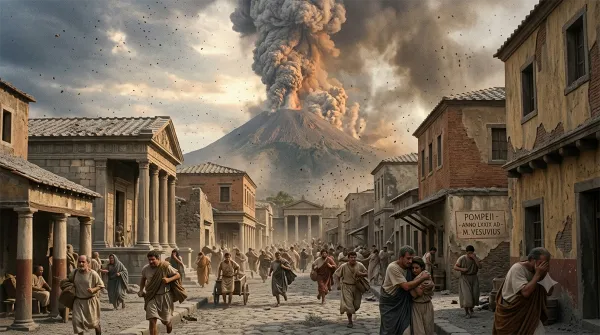
The Day Vesuvius Froze a City
August 79 AD. Mount Vesuvius erupted without warning and buried two Roman towns under meters of ash, preserving a snapshot of ordinary life for nearly two thousand years.
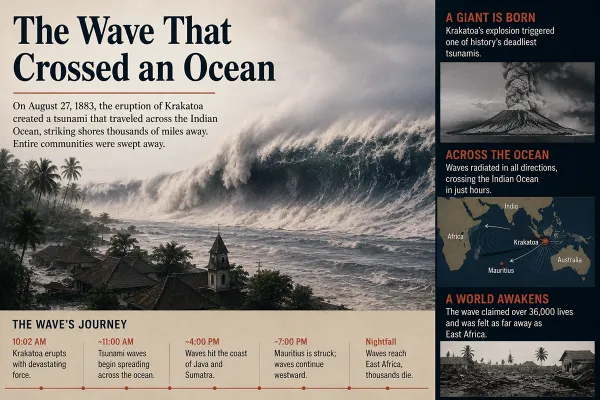
The Wave That Crossed an Ocean
December 26, 2004. A magnitude 9.1 earthquake off Sumatra tore open the seafloor and sent walls of water across the Indian Ocean, killing nearly a quarter of a million people in hours.