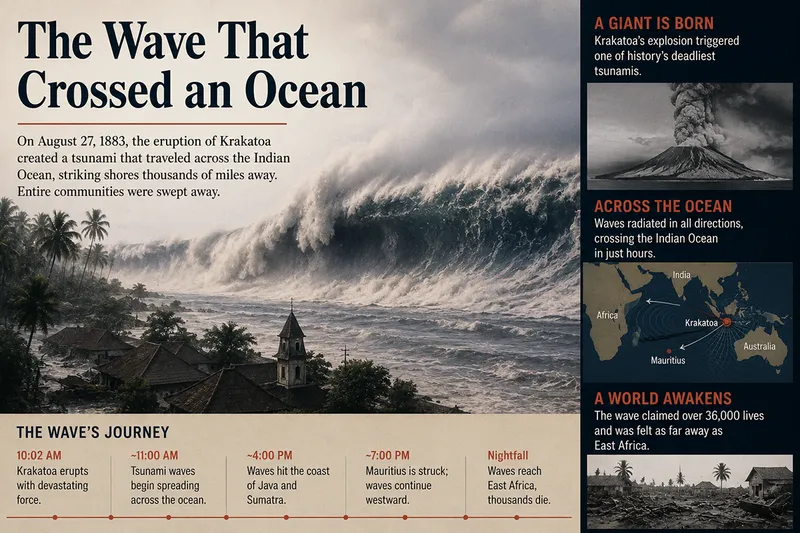
The Wave That Crossed an Ocean
December 26, 2004. A magnitude 9.1 earthquake off Sumatra tore open the seafloor and sent walls of water across the Indian Ocean, killing nearly a quarter of a million people in hours.
WOW Score
The quake was the third most powerful ever recorded, ripping a 1,000-mile fault and lifting the seabed by several meters in an instant.
Because the Indian Ocean had no tsunami warning network, coastal communities from Indonesia to Somalia were struck with little or no notice, some within minutes, others within hours.
Tourists with camera phones captured the first raw footage, and within days the world watched a catastrophe unfold in real time, donating billions to the relief effort.
"There was no ocean-wide warning system. In some places the sea pulled back a mile, then returned as a wall, giving people minutes, sometimes seconds, to run."
The disaster became the deadliest tsunami in history and the deadliest natural disaster of the 21st century so far, spurring a global tsunami warning system and an unprecedented outpouring of humanitarian aid.
The Full Story
The Great Rupture
At 7:58 a.m. local time, the Indo-Australian Plate slipped beneath the Eurasian Plate off the coast of Aceh, Indonesia, releasing energy equivalent to tens of thousands of bombs. The seafloor heaved, and the displacement of that much water was the engine of the waves to come.
No Warning
The Pacific had long had a tsunami warning system, but the Indian Ocean did not. Scientists detected the quake but had no way to forecast or broadcast the wave to vulnerable coasts. The result was a disaster measured in lost minutes that could have been saved lives.
The Wave Arrives
In Aceh, waves up to 30 meters high struck within 15 minutes. Elsewhere, the sea first retreated dramatically, luring the curious onto exposed seabed before the water returned as a black wall. Train lines, villages, and entire coastlines were erased.
A Regional Catastrophe
Fourteen countries were hit, from Indonesia and Thailand to Sri Lanka, India, and the Maldives, with deaths reported as far as Somalia. Nearly a quarter of a million people died and millions were displaced, making it the deadliest tsunami in recorded history.
Recorded by Tourists
Unlike earlier disasters, this one unfolded on digital cameras and early social media. Amateur video of the advancing water became the world's first live window into a continental-scale catastrophe, accelerating the global response.
The Aid Response
Governments and individuals donated at historic levels, with pledges exceeding $13 billion. Navies from multiple countries mounted one of the largest relief operations ever, delivering food, water, and medicine to isolated coastlines.
Building the Alarm
The tragedy produced the Indian Ocean Tsunami Warning and Mitigation System, a network of buoys and seismic sensors designed to give coastal populations the minutes that 2004 denied them. The lesson was that warning systems save lives that engineering alone cannot.
The Turning Moment
The turning point was the absence of a warning where one was possible. A disaster that science could have softened instead became a monument to neglected preparedness, and the world resolved, too late for many, never to be caught so silently again.
Lasting Legacy
The 2004 tsunami reshaped disaster policy, early-warning infrastructure, and humanitarian funding worldwide. It remains the defining natural catastrophe of the early 21st century and the clearest evidence that timely information is itself a form of shelter.
Related Turning Moments
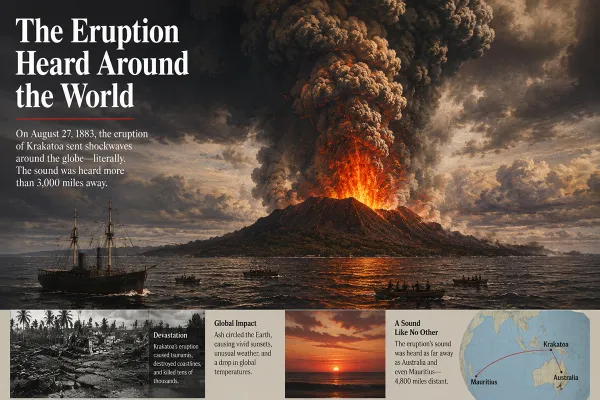
The Eruption Heard Around the World
August 27, 1883. A small island volcano between Java and Sumatra detonated with a blast heard 3,000 miles away, and the sea rose to swallow hundreds of villages.
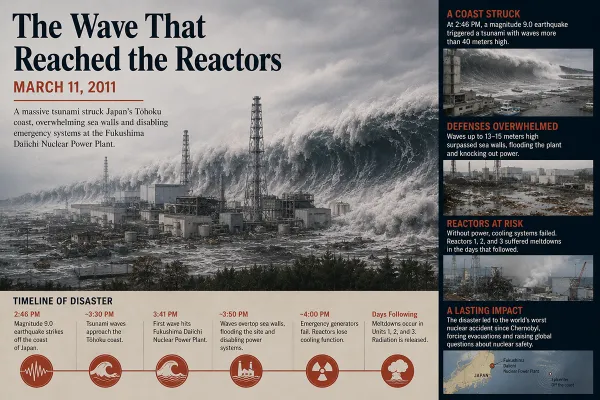
The Wave That Reached the Reactors
March 11, 2011. A massive earthquake and tsunami knocked out the cooling at Japan's Fukushima plant. The world's third-worst nuclear disaster unfolded on live television.
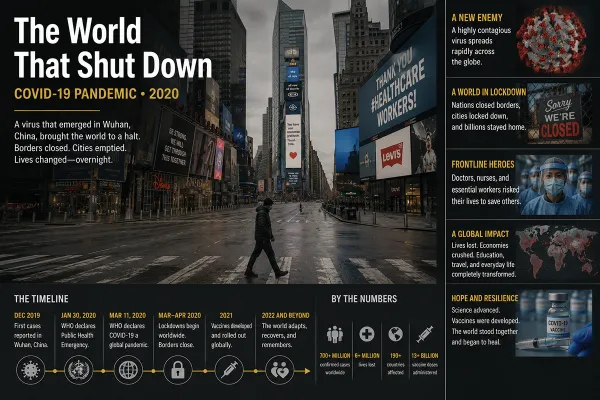
The World That Shut Down
Early 2020. A novel coronavirus spread from a Chinese city and, within weeks, emptied the streets of every major country on Earth. Modern life paused all at once.