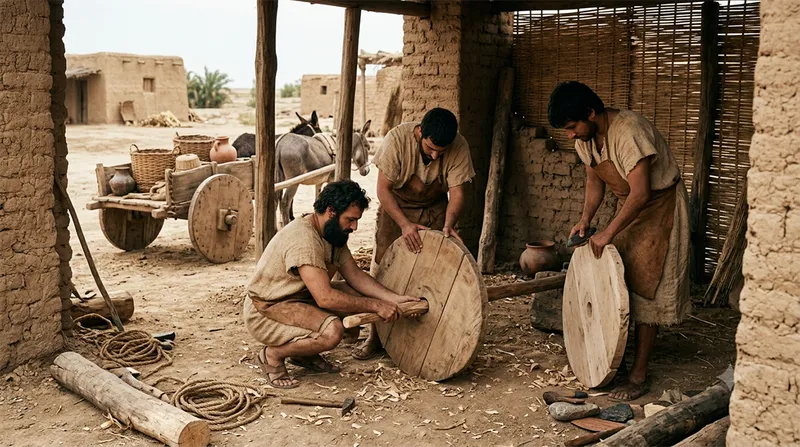
The Invention of the Wheel: The Circle That Moved the World
A simple disc of wood seems obvious now. But for most of human existence it didn't exist and once it appeared, nothing could move the same way again.
WOW Score
Around 3500 BC, in the Mesopotamian city of Uruk, someone shaped a flat disc and set it spinning. The wheel was born not as a cart wheel, but as a potter's wheel, a tool for shaping clay with newfound speed and symmetry.
Within centuries, that same idea was mounted on axles to carry loads. Carts hauled grain, chariots carried soldiers, and the logic of rotation spread into every corner of technology.
Today the wheel is so everywhere we forget it was once a discovery: a circle that turns friction into motion, and effort into progress.
"The wheel wasn't invented to roll. It was invented to turn and that distinction remade pottery, transport, and time itself."
The wheel transformed how humans made things and moved them. A potter's wheel standardized clay vessels; carts and chariots moved goods and armies faster than any porter or pack animal; wheels became pulleys, gears, and flywheels the hidden grammar of every machine that followed, from clocks to cars to turbines.
The Full Story
Spinning Before Rolling
The earliest wheels were not for transport. Archaeological evidence points to the potter's wheel appearing in Mesopotamia around 3500 BC, with wheeled vehicles arriving roughly 300 years later in the Eurasian steppes. The first use of rotation was to make things, not move them a telling reminder that invention often finds its second act later.
The Axle Problem
A wheel alone does nothing; it needs an axle that lets it spin while the load stays still. Solving this a fixed axle on the cart, or a wheel fixed to a rotating axle was the real engineering leap. Once cracked, carts could carry tonnes where backs could carry kilograms.
War on Wheels
The spoked wheel made chariots light and fast, giving the Hittites, Egyptians, and Assyrians a mobile strike force. For two thousand years the chariot decided battles, projected power, and symbolized royalty the original expression of speed as supremacy.
The Invisible Wheels
Most wheels you never see. They hide inside gears, pulleys, turbines, and clocks turning force, lifting water, keeping time. The Industrial Revolution was, at heart, a festival of wheels: flywheels smoothing steam power, gears multiplying it, spinning machines weaving the modern economy.
Why the Wheel Is Everywhere
Some societies, like the Maya, never adopted the wheel for transport despite knowing the concept because without draft animals and smooth roads it offered little. The wheel's triumph shows that invention depends on context. Where the conditions aligned, no single idea did more to multiply human effort.
Related Turning Moments
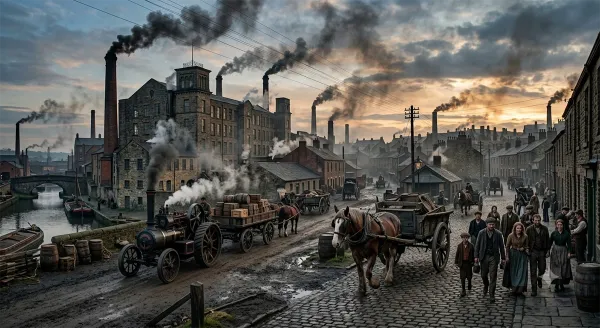
The Industrial Revolution: When Steam Replaced Muscle
In a single generation, humans stopped relying on the strength of their backs and started harnessing coal, iron, and machines. Nothing was ever the same.

The Discovery of Fire: How Humans Tamed the Flame
Before cities, before farming, before language as we know it, one species learned to hold lightning in its hands. Everything changed.
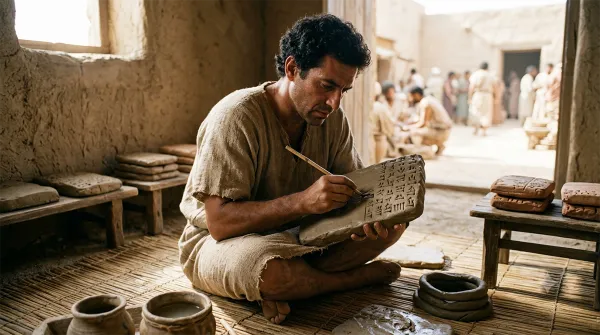
The Birth of Writing: When Humans Learned to Outlive Themselves
Memory fades. Voices die. But around 3200 BC, someone pressed signs into clay and suddenly human thought could survive its speaker.