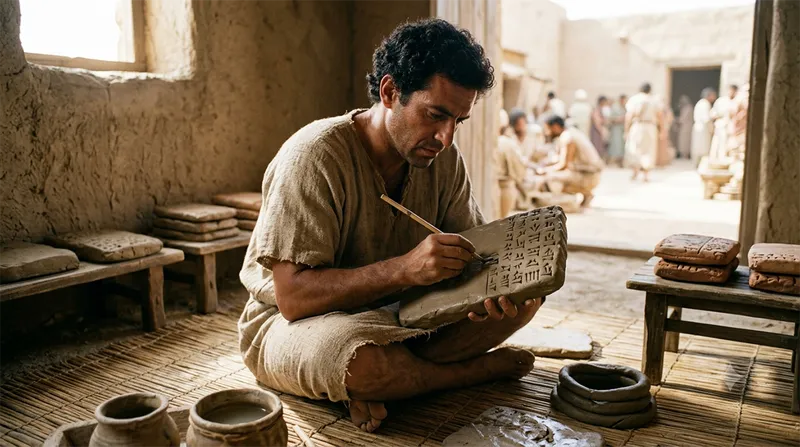
The Birth of Writing: When Humans Learned to Outlive Themselves
Memory fades. Voices die. But around 3200 BC, someone pressed signs into clay and suddenly human thought could survive its speaker.
WOW Score
In the fertile floodplains between the Tigris and Euphrates, the Sumerians faced a problem of success: their cities produced more grain, cattle, and trade than any memory could track. So they invented a solution marks on clay.
At first it was accounting: pictographs counting barley and cattle. Over centuries those signs abstracted into cuneiform, a script that could record laws, stories, and prayers.
With writing, knowledge escaped the limits of the human brain. A king's decree could outlive the king. Civilization learned to remember.
"Writing is the first technology that let one mind speak to another across a thousand years and a thousand miles. Nothing else comes close."
Writing turned fragile oral memory into durable record. It enabled law codes, contracts, and accounting the paperwork of states and economies. It carried literature, science, and religion beyond any single lifetime, and it made possible every later information technology, from the printing press to the internet.
The Full Story
From Tokens to Tablets
Before writing, the Sumerians used clay tokens to represent goods. Around 3200 BC they began impressing those tokens' shapes onto wet clay tablets and adding marks for quantity the first true writing. The world's oldest deciphered sentence, from the Kish Tablet, dates to roughly this time.
Why Accountants Invented Literature
Writing began as bureaucracy, not poetry. Temples and palaces needed to track taxes, rations, and herds. But once a society could write 'ten sheep,' it could also write 'Inanna descends to the underworld.' The Epic of Gilgamesh, inscribed soon after, is among the first great stories humanity ever told itself in permanent form.
The Birth of Law and History
Writing made codes possible. Centuries later, Hammurabi's laws (see the Code of Hammurabi) could be carved for all to see, fixing rules beyond a ruler's mood. It also created history: annals, treaties, and chronicles that let societies learn from their own past instead of forgetting it.
Independent Inventions
Writing was 'invented' at least four times, independently: Sumerian cuneiform, Egyptian hieroglyphs, Chinese logographs, and Mesoamerican scripts. Each emerged from complex societies that needed to store and transmit information proof that literacy is less a gift than a necessity of civilization.
The Long Echo
Every system that stores information descends from those clay marks: the alphabet, the book, the database, the screen you are reading now. Writing is the backbone of cumulative human progress the reason we know more than our ancestors instead of starting from zero.
Related Turning Moments
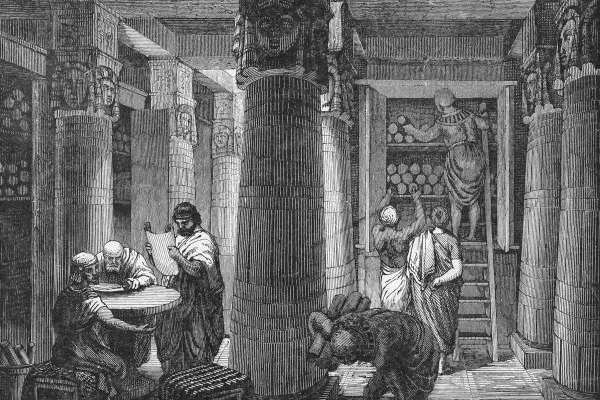
The Library of Alexandria's Destruction
For centuries, the greatest library on Earth held the collected knowledge of humanity. Then fire, war, and time erased most of it forever.
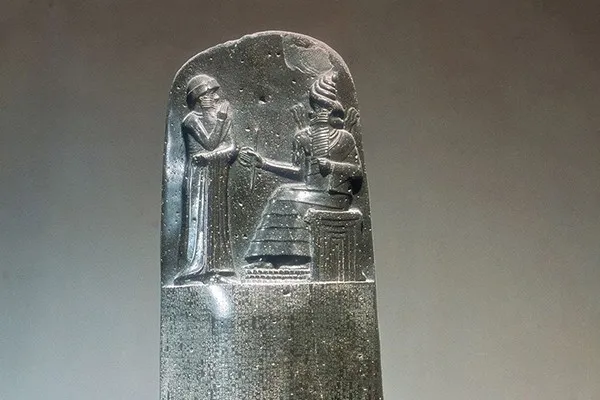
The Code of Hammurabi
c. 1754 BCE. A Babylonian king carved 282 laws into a stone pillar for all to see. It was one of the first times a society said: the rules apply to everyone.

The Printing Press: How Movable Type Flooded the World with Ideas
In 1450, a single book took a monk months to copy. Then Johannes Gutenberg built a machine that could print thousands and the monopoly on knowledge shattered.