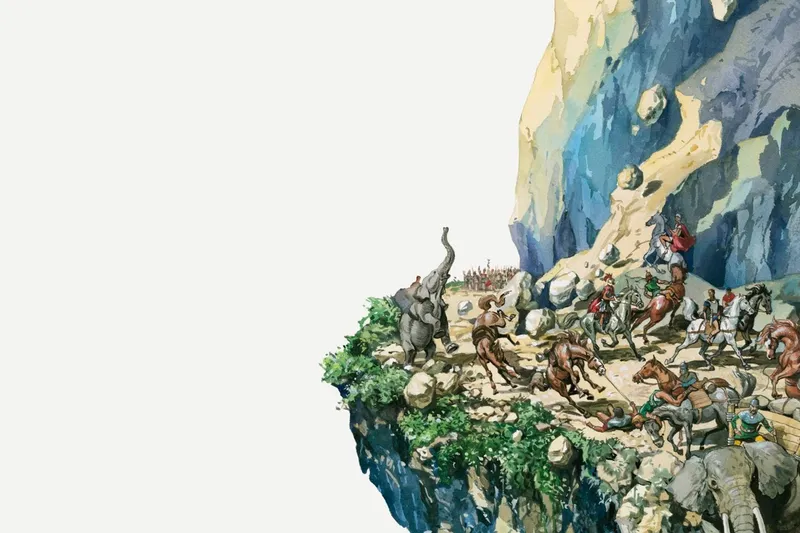
Hannibal Crosses the Alps
218 BCE. A Carthaginian general led war elephants over the frozen Alps to strike Rome from behind. It remains the most audacious military march in history.
WOW Score
Hannibal Barca vowed hatred for Rome from childhood. Rather than fight the Republic on its terms, he marched an army from Spain, across southern Gaul, and up into the Alps.
The crossing killed thousands of men and most of the elephants in snow, rockfalls, and ambushes by mountain tribes. But those who survived descended into Italy as a terrifying surprise.
For over a decade, Hannibal ravaged the Italian peninsula, defeating every Roman army sent against him, yet he never took the city itself.
"He did not take the safe road to Rome. He took the impossible one and nearly won the war because of it."
Hannibal's crossing shocked Rome, won stunning victories at Trebia, Trasimene, and Cannae, and forced Rome to reinvent its military. The Second Punic War reshaped the Mediterranean and set Rome on the path to empire.
The Full Story
The Oath of a Boy
Hannibal's father, Hamilcar, made his nine-year-old son swear eternal enmity to Rome at a temple altar. That vow became the engine of his life. As Carthage's young general in Spain, he built an army loyal to him personally, a blend of Africans, Spaniards, and Gauls bound by his leadership rather than any state.
The Impossible Road
No one expected an army to cross the Alps in late autumn. Hannibal's route is still debated, but the ordeal is not: freezing temperatures, narrow trails, and hostile tribes picked off the column. Of perhaps 50,000 men and dozens of elephants who began, only about 20,000 infantry and a handful of elephants reached Italy. Yet the survivors were hardened veterans, and Rome was completely unprepared.
Cannae: The Perfect Battle
At Cannae in 216 BCE, Hannibal surrounded and destroyed a far larger Roman army using a double-envelopment still studied in war colleges. Up to 50,000 Romans died in a single day. It was the worst defeat in Roman history, and yet Rome, astonishingly, refused to make peace, raising new armies from boys and freed slaves.
The General Who Could Not Close
Hannibal's greatest weakness was strategic: he could not take Rome itself, and Carthage never sent the reinforcements to do it. Rome, under Fabius's strategy of delay and Scipio's counterattack in Africa, eventually brought the war home to Carthage. Hannibal was recalled to defend his city and was defeated at Zama in 202 BCE.
The Turning Moment
Everything turned on the decision to climb the Alps instead of sailing or attacking Sicily, a choice born of sheer daring that redefined what an army could do. The crossing did not win the war, but it put Rome at the edge of extinction and proved that republics could be terrified by a single gifted enemy. Hannibal's march is the moment courage and logistics became legend.
Lasting Legacy
Hannibal remains the archetype of the brilliant underdog general, taught at military academies for his use of terrain, deception, and envelopment. His war ended Carthage's status as a great power and cleared Rome's path to dominate the Mediterranean. Whether remembered as the man who almost destroyed Rome or the genius who crossed the impossible, one fact is already clear: in 218 BCE, Hannibal turned mountains into a battlefield.
Related Turning Moments
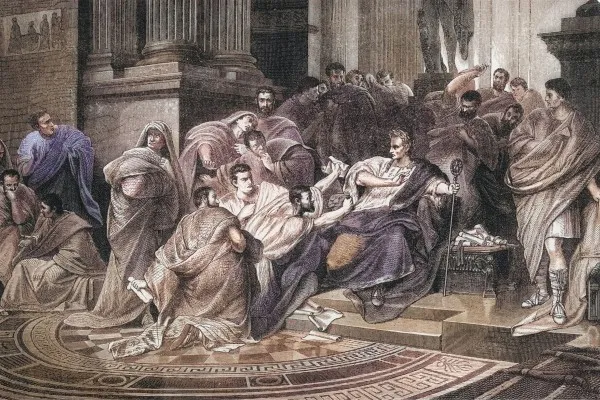
The Day Julius Caesar Was Assassinated
March 15, 44 BCE. The most powerful man in Rome walked into the Senate expecting tribute. He left dead on the floor, stabbed 23 times by men he called friends.
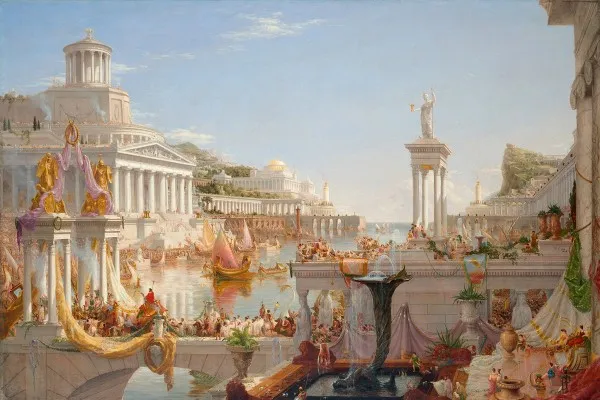
The Fall of the Roman Empire
September 4, 476 CE. A Germanic warrior deposed the last Roman emperor in the West. The empire that ruled the known world for centuries ended not with a bang, but with a quiet surrender.
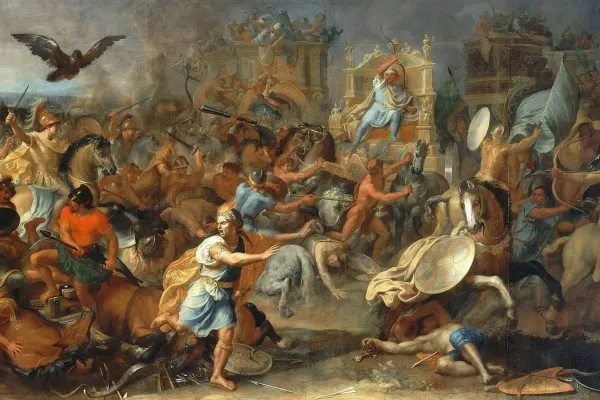
The Battle of Thermopylae
480 BCE. Three hundred Spartans held a mountain pass against an army of millions. They lost, but their stand became the most famous last stand in history.