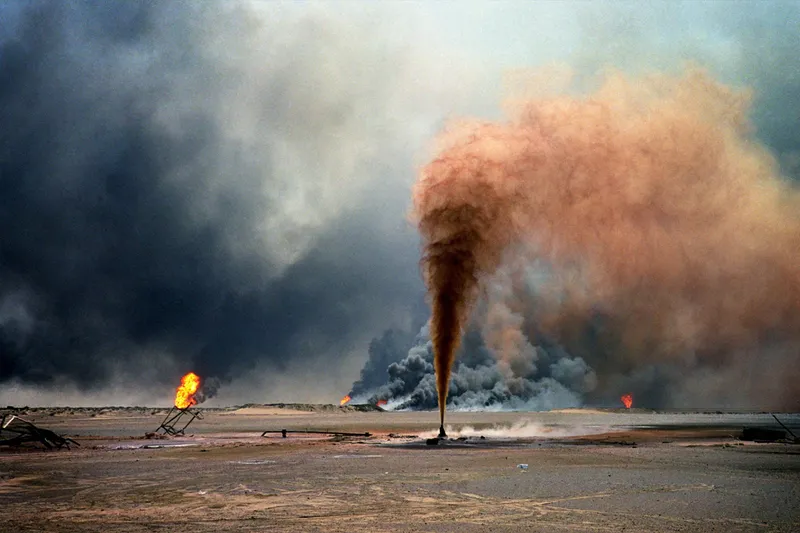
The Gulf War: The War the World Watched Live
January 17, 1991. For the first time, viewers at home watched missiles streak through the night on live television. War became a broadcast.
WOW Score
When Iraq invaded Kuwait in 1990, a U.S.-led coalition assembled the largest force since World War II to expel it.
Operation Desert Storm opened with a stunning air campaign: satellite-guided bombs hit targets with near surgical precision, shown live on CNN.
The ground war lasted just 100 hours. A vast army was defeated in days, and the era of televised, high-tech war began.
"It was the first war where the bombs had camera crews and the world watched it like a movie."
The Gulf War showcased precision-guided 'smart' weapons and real-time coverage, revolutionizing both warfare and war reporting. It reshaped U.S. military doctrine, the Middle East's balance, and the media's role in conflict.
The Full Story
The Invasion of Kuwait
In August 1990, Saddam Hussein's Iraq invaded neighboring Kuwait, citing a dispute over oil and borders. The world, led by the U.S. and backed by a U.N. mandate, refused to accept it. A coalition of dozens of nations built up forces in Saudi Arabia in Operation Desert Shield, the largest such assembly since 1945.
The Night the Sky Lit Up
On January 17, 1991, waves of stealth fighters, cruise missiles, and laser-guided bombs struck Baghdad and Iraqi positions. Viewers worldwide watched live as the city's sky lit with anti-aircraft fire and explosions. The 'video game' footage from missile cameras was unprecedented and changed how the public experienced war.
The Hundred-Hour War
After five weeks of bombing, the ground assault began on February 24 and ended in roughly 100 hours. Iraqi forces collapsed and fled the 'Highway of Death' toward Basra. Kuwait was liberated, but the decision to stop short of Baghdad left Saddam in power, a choice that shaped later conflicts.
War as Television
The Gulf War was the first conflict covered in real time by 24-hour news, with embedded reporters and military-pool footage. It revealed both the power and the limits of live coverage: the public saw precision strikes but rarely the wounded or the messy aftermath. War reporting, and military public relations, were never the same.
The Turning Moment
Everything turned on the advent of precision weapons and live satellites that turned a distant conflict into a global living-room event. The Gulf War proved that technology could make war look clean and quick, a lesson that outlived the war itself. It marked the start of the modern, media-saturated age of conflict.
Lasting Legacy
The Gulf War reshaped U.S. military doctrine around speed, precision, and air power, and left a permanent U.S. presence in the Gulf. It redrew the Middle East's politics and set the stage for later interventions. Whether remembered as a triumph of technology or a conflict left unfinished, one fact is already clear: in 1991, war entered the live-TV age.
Related Turning Moments
D-Day: The 24 Hours That Decided WWII
At 6:30 AM on June 6, 1944, the world held its breath as 156,000 Allied troops stormed five beaches into the unknown.
The Battle of Stalingrad
August 1942 – February 1943. The bloodiest battle in human history turned the tide of World War II in the ruins of one city.
The Six-Day War
June 1967. In less than a week, Israel fought three Arab armies and redrew the Middle East. The map has not been the same since.