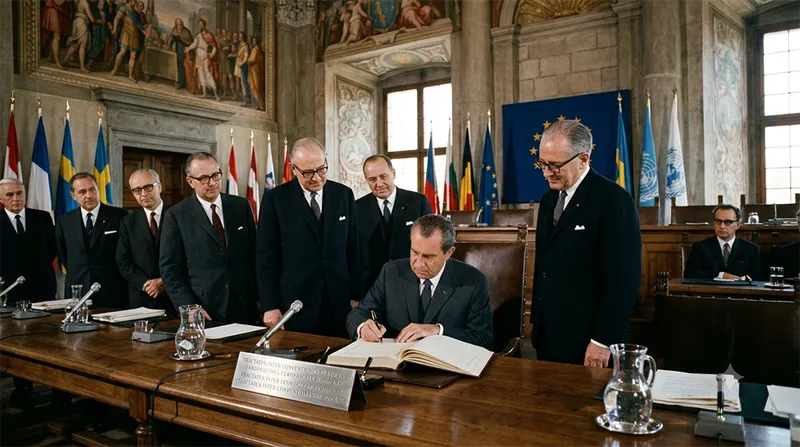
The Treaty That Made Europe One Market
November 1, 1993. After four decades of cautious economic cooperation, twelve European nations completed a treaty that turned a loose club into something closer to a single country: the European Union.
WOW Score
The European Coal and Steel Community of 1951 had begun simply: France and Germany would pool the industries that made war, so war would become 'not merely unthinkable, but materially impossible.'
Over four decades, that logic grew into the European Economic Community, a common market. The 1992 Maastricht Treaty pushed far further, adding shared citizenship, a common foreign policy, and a plan for a single currency.
When the treaty took effect in 1993, the European Union was born, replacing the old community and pledging 'an ever closer union among the peoples of Europe.'
"Centuries of wars between France and Germany ended not with a treaty of peace but with a shared currency, a shared parliament, and a single market."
The EU deepened integration to an unprecedented degree, created the euro, expanded across the continent, and turned Europe into a single economic space of hundreds of millions, while also breeding new tensions over sovereignty.
The Full Story
From Steel to Union
After two world wars born on European soil, statesmen like Jean Monnet and Robert Schuman proposed a radical cure: bind the continent's economies so tightly that conflict would be irrational. The 1951 Coal and Steel Community was the first brick. The 1957 Rome Treaties created the European Economic Community, a tariff-free zone among six nations.
The Single Market Dream
By the 1980s, Europe lagged behind a booming America and Japan. The 1986 Single European Act set a deadline to remove all barriers to the free movement of goods, people, services, and capital, the celebrated 'four freedoms.' The internal borders of Europe began to fade, and with them a thousand years of rivalry.
Maastricht
Negotiated in a Dutch border city in 1991 and signed in February 1992, the Maastricht Treaty was ambitious beyond anything before it. It created the EU as a legal entity, gave citizens EU citizenship, sketched a common foreign and security policy, and committed members to converge their economies toward a single currency, the euro.
Ratification Fights
Maastricht was not a quiet triumph. Voters in Denmark rejected it first, then approved it after concessions; the French approved it by a razor-thin margin; and Britain won opt-outs from the euro and the social chapter. The debates revealed a persistent tension between deeper unity and national sovereignty that the union has never fully resolved.
A New Kind of Polity
The EU that emerged was unlike any previous organization: not a state, not merely a treaty, but a hybrid with its own parliament, court, commission, and flag. Decisions moved between Brussels and national capitals in a constant, contested dance. It was federalism by stealth, achieved through practical cooperation rather than a founding constitution.
The Euro Arrives
Maastricht set the rules; the currency followed. In 1999 the euro launched electronically, and in 2002 banknotes and coins replaced national currencies in twelve countries. For the first time since Rome, much of Europe shared a single money, a powerful symbol and a real economic engine, with all the discipline and risk that implied.
Expansion and Strain
The end of the Cold War let the EU take in former communist states, growing from twelve to twenty-seven members. But enlargement stressed the system, and the 2008 debt crisis exposed the fragility of a monetary union without a full fiscal one. Brexit in 2016 was the first reversal of the 'ever closer union.'
The Turning Moment
The turning point was the decision to pursue not just trade but political union, accepting shared sovereignty as the price of permanent peace. A continent that had spent centuries at war chose, in Maastricht, to merge its fate so completely that leaving would mean unbuilding a half-century of integration.
Lasting Legacy
The European Union turned a battlefield into a single market and kept the peace among its members for generations. It reshaped law, travel, and trade for half a billion people, even as it struggles with the eternal question Maastricht dodged: how much unity, and at what cost to the nation. Its creation in 1993 is the modern pivot of European history.
Related Turning Moments
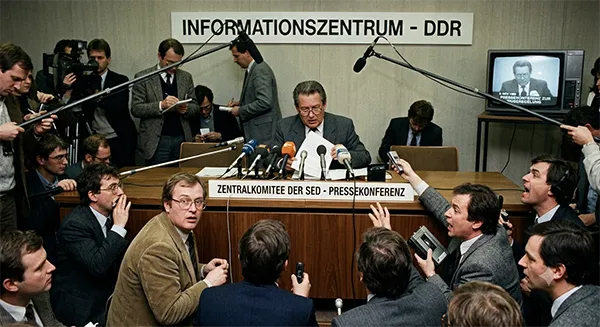
The Press Conference Mistake That Brought Down a Wall
November 9, 1989. An East German spokesman misread a note. Within hours, hammers were breaking through concrete that had divided a continent for 28 years.
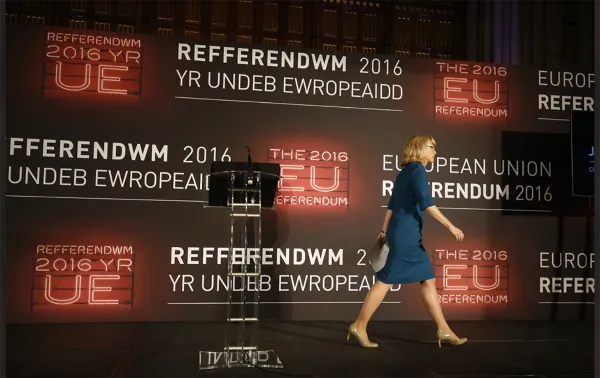
The Night Britain Left the Room
June 23, 2016. Pollsters, markets, and nearly every expert said Britain would stay in the EU. The voters went the other way, and a political order shuddered.
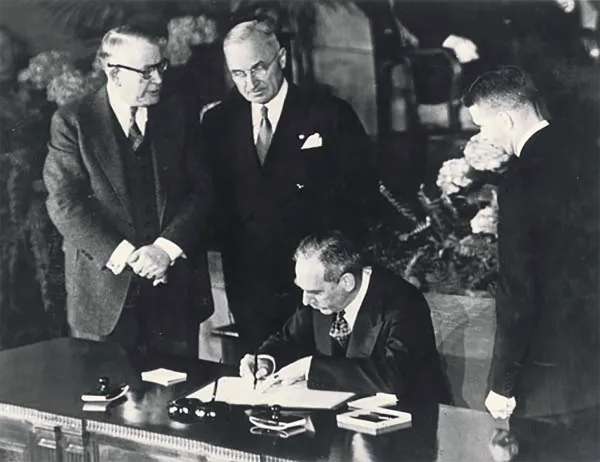
The Alliance That Froze the Front Line
April 4, 1949. Twelve nations signed a treaty in Washington promising that an attack on one would be an attack on all. For the first time, the Americas and Europe bound their defenses as one.