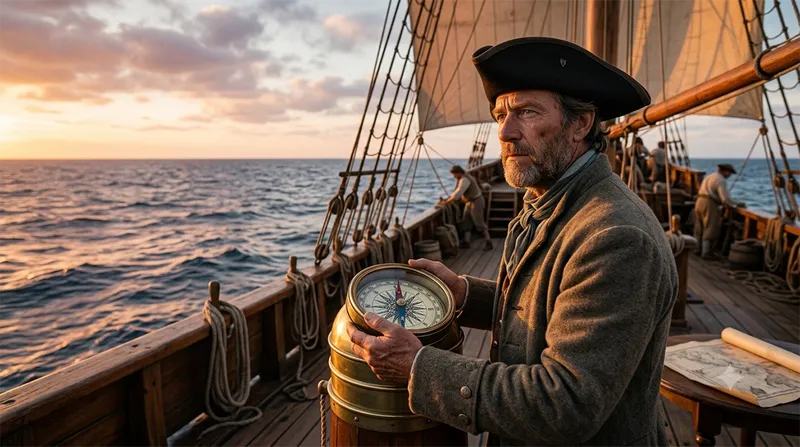
The Compass: The Needle That Showed Humans the Way
For most of history, travelers trusted the sun, the stars, and prayer. Then a floating lodestone needle pointed north and the world became mapable.
WOW Score
The earliest compasses were not nautical at all. Chinese diviners of the Han dynasty spun lodestone spoons on polished boards to read the future and noticed the spoon always settled pointing south.
By the 11th century, Chinese sailors were using magnetized needles to find their bearing at night or in clouds. The idea spread west along trade routes, and European navigators adopted it just in time for the great voyages.
With a compass, a captain no longer needed to see the coast. The ocean became a road, and the age of global connection began.
"A sliver of magnetized iron did what no map could: it worked at night, in fog, and far from any shore. It turned the unknown into a route."
The compass made open-ocean navigation possible, enabling the Age of Exploration, global trade, and the first world-spanning empires. It anchored later technologies from the marine chronometer to the smartphone's magnetometer, and it shifted human confidence from 'stay near land' to 'the whole Earth is reachable.'
The Full Story
Lodestone and Lore
Naturally magnetized lodestone was known to the Chinese as 'south-pointer' by the 2nd century BC. Early devices were carved spoons balanced on bronze plates, used for geomancy (feng shui) rather than travel. The leap from ritual object to practical instrument took a millennium of tinkering.
The Floating Needle
The crucial innovation was magnetizing a steel needle by rubbing it with lodestone and floating it on water or suspending it on a silk thread. Described in the Chinese text Pingzhou Table Talks (1119), this cheap, portable compass reached ships and, via Arab traders and merchants, the Mediterranean by the 13th century.
Unlocking the Open Ocean
European navigation had hugged coastlines; the compass let ships steer a steady course into the Atlantic, around Africa, and across to the Americas. Paired later with the quadrant, the astrolabe, and the marine chronometer, it made the globe navigable and launched the Columbian exchange of peoples, crops, and calamity.
A Tool of Empires
Whoever had the compass had the map. Portugal, Spain, the Netherlands, and Britain built maritime empires on it, redrawing the world's political map. The same needle that guided merchants also guided fleets, missionaries, and conquest.
The Needle in Your Pocket
The compass never went away. Ships, aircraft, and hikers still carry one, and your phone contains a tiny magnetometer that does the same job a thousand times a second. The quietest revolution in navigation is also the one still running, silently, in your hand.
Related Turning Moments
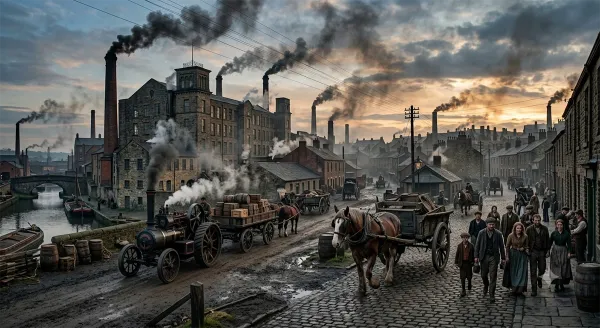
The Industrial Revolution: When Steam Replaced Muscle
In a single generation, humans stopped relying on the strength of their backs and started harnessing coal, iron, and machines. Nothing was ever the same.

The Printing Press: How Movable Type Flooded the World with Ideas
In 1450, a single book took a monk months to copy. Then Johannes Gutenberg built a machine that could print thousands and the monopoly on knowledge shattered.

Gunpowder: The Powder That Ended the Knight
A Chinese alchemist hunting for eternal life mixed saltpetre, sulfur, and charcoal. He found something far more powerful and far more destructive.