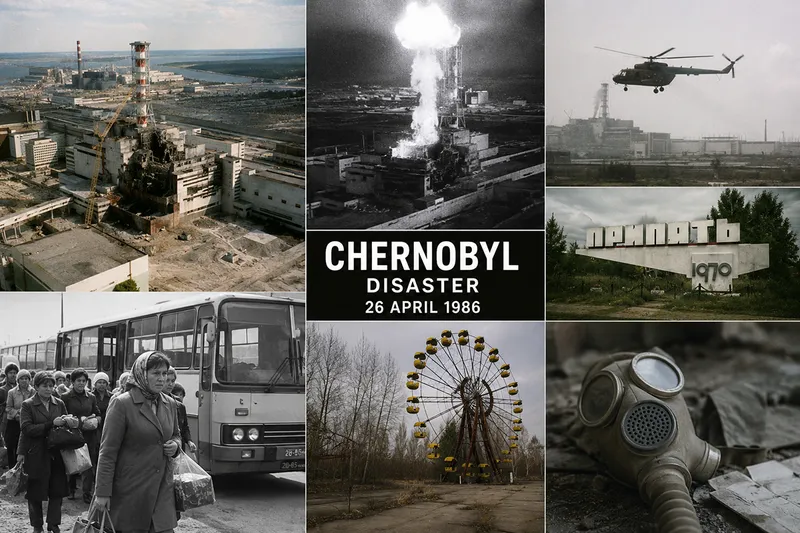
The Test That Melted a Reactor
April 26, 1986. Engineers at a Soviet power plant ran a routine safety test. Within seconds, a reactor exploded with the force of dozens of Hiroshima bombs, and an invisible cloud set out across Europe.
WOW Score
Reactor 4 at Chernobyl was a Soviet RBMK design with a dangerous flaw: at low power, it could surge uncontrollably, a fact hidden from its own operators.
During a planned test, workers accidentally drove the reactor into a precarious state, then hit the emergency shutdown, which briefly spiked its power a hundredfold and blew the 1,000-ton lid clean off the building.
Firefighters arrived with no idea they were battling a radiological inferno; many would die within weeks. The Soviet Union lied for days, even as fallout triggered alarms at a nuclear plant 600 miles away in Sweden.
"The control room first thought the reactor was intact. It had been vaporized; they were standing beside an open, radioactive wound in the earth."
Chernobyl became the worst nuclear accident in history, poisoned a wide swath of Europe, bankrupted the Soviet effort to expand nuclear power, and became the enduring symbol of the cost of secrecy and hubris.
The Full Story
A Flawed Machine
The RBMK reactor was powerful and cheap, but its graphite-tipped control rods and positive void coefficient made it unstable at low power. Soviet designers knew this and kept it secret. Operators at Chernobyl were never told that pulling the wrong levers could turn the plant into a bomb.
The Night Shift
Just after midnight, a relatively inexperienced crew took over to run a test of whether the turbine could power the cooling pumps during a blackout. A series of delays and violations left the reactor at far too low a power level, poisoned by neutron-absorbing byproducts, and stripped of safety systems.
The Surge
As the test began, an operator withdrew too many control rods. Power crept up, then, when the emergency shutdown was triggered, momentarily spiked to roughly a hundred times normal as the rods' graphite tips displaced coolant. The fuel shattered, steam exploded, and a second, more violent blast followed.
The Liquidators
Hundreds of firefighters, soldiers, and miners, the 'liquidators', were sent to extinguish the fires, bury the debris, and tunnel beneath the reactor to stop a catastrophic meltdown into the water table. Many acted knowing the dose could be fatal; the Soviet state awarded them posthumously and pressed on in silence.
The Cover-Up
Moscow delayed evacuation of the nearby city of Pripyat for more than a day, even as children played outside in a radioactive drizzle. Only when radiation alarms sounded at a Swedish nuclear plant did the world learn the truth. The curtain of official deception was one of the disasters' most damaging casualties.
An Exclusion Zone
More than 100,000 people were eventually evacuated from a 30-kilometer exclusion zone that remains largely uninhabitable today. Vast tracts of Belarus, Ukraine, and Russia were contaminated; forests turned red and then silent. The full human toll of cancer and displacement is still debated, but the spatial scar is permanent.
The End of an Era
Chernobyl shattered faith in Soviet competence and in nuclear power worldwide. Construction of new reactors stalled for years, and the catastrophe became a rallying point for openness that helped crack the system already weakening under Gorbachev. The sarcophagus over the ruins still requires maintenance decades on.
The Turning Moment
A single botched test turned a peacetime machine into an instrument of continental contamination. The turning point was not the explosion alone but the lie that followed: a state that could not admit the truth lost the last of its moral authority, and the world learned how far a secret could travel on the wind.
Lasting Legacy
Chernobyl reshaped energy policy, emergency planning, and the politics of transparency for a generation. It stands as the grim bookend to the nuclear age's promise, a reminder that the most catastrophic events are often engineered not by malice but by routine, unexamined error.
Related Turning Moments
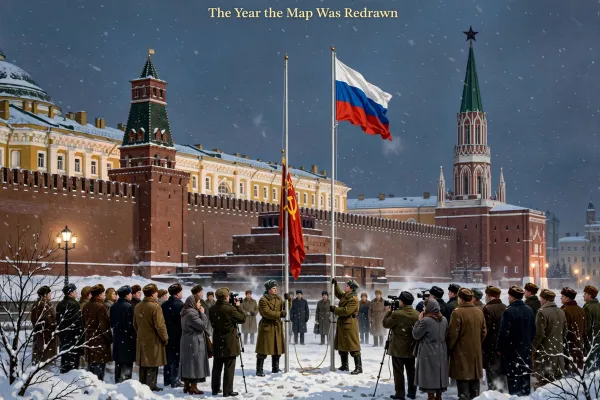
The Year the Map Was Redrawn
December 25, 1991. The red flag over the Kremlin came down for the last time. A superpower that had threatened the world with nuclear annihilation for forty years simply ceased to exist.
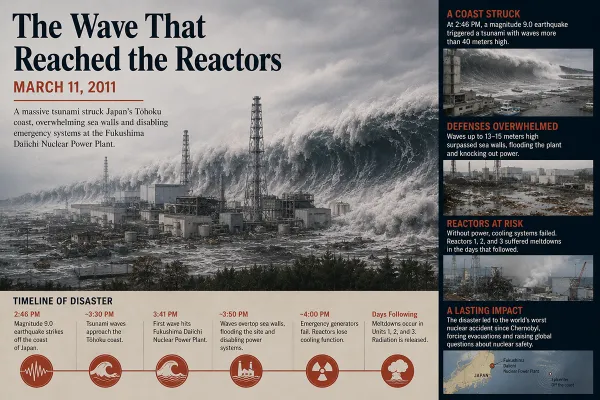
The Wave That Reached the Reactors
March 11, 2011. A massive earthquake and tsunami knocked out the cooling at Japan's Fukushima plant. The world's third-worst nuclear disaster unfolded on live television.
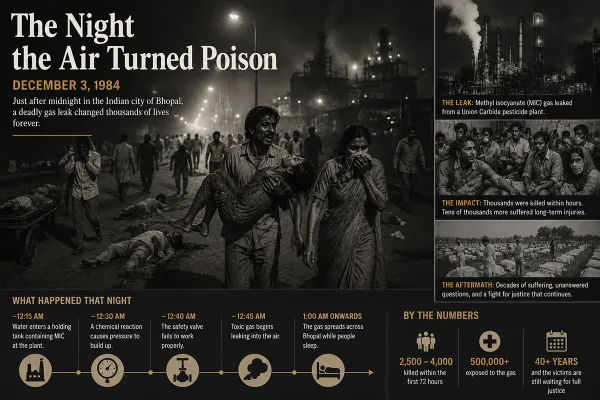
The Night the Air Turned Poison
December 3, 1984. Just after midnight in the Indian city of Bhopal, a pesticide plant leaked a cloud of deadly gas. In the darkness, thousands suffocated before they could understand what was happening.