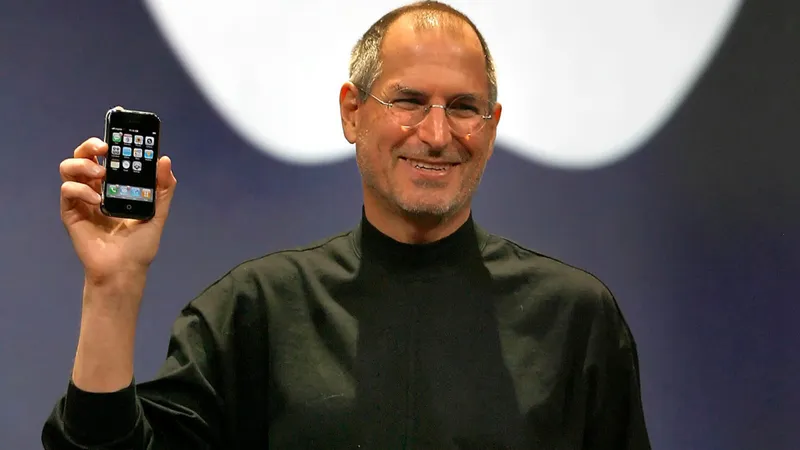
The Keynote That Killed the Keyboard
January 9, 2007. Steve Jobs held up a device and said three things. It was actually one thing. The room didn't understand yet but the phone industry was already over.
- Company
- Apple
- Year
- January 9, 2007
- Category
- Hardware
- First-year units sold
- 1.39 million
- Launch price
- $499
- App Store launched
- 2008
WOW Score
Rumors had circulated for years about an Apple phone, but nobody in the Macworld audience was prepared for what Jobs unveiled. No stylus, no physical keyboard, no visible buttons beyond one.
The reveal followed a now-famous misdirection: Jobs announced three products a widescreen iPod, a phone, an internet communicator before revealing they were the same device.
Competitors initially dismissed it. Within two years, the smartphone market had been completely redrawn around Apple's touch-first design language, and it never went back.
"An iPod, a phone, an internet communicator. Jobs paused. 'These are not three separate devices. This is one device.'"
The physical keyboard, the dominant phone design for a decade, was functionally extinct within three years. App-based computing replaced desktop-first computing as the default global experience. An entire economy the app store model didn't exist yet and would soon employ millions.
The Full Story
The Phones Before the iPhone
In early 2007, the smartphone was a serious business tool, not a joy. BlackBerrys ruled the corporate world with tiny physical keyboards, Palm and Windows Mobile devices ran on styluses and resistive screens that demanded a firm poke, and Nokia's Symbian handsets dominated global volume with cramped number pads and buried menus. Browsing the real web on any of them was slow, awkward, and often impossible. Apple, a computer maker with one hit music player, was not on anyone's list of companies about to reinvent the phone.
Project Purple: The Secret That Ate the Company
The device began as an internal skunkworks effort called Project Purple, started around 2005 and run out of a locked building whose doors bore a sign: 'Fight Club.' Jony Ive's industrial-design team and a small group of engineers pursued a radical idea: a phone controlled entirely by a finger on a glass screen. Early prototypes were crude, fragile, and unreliable, and the work pulled talent and attention away from other Apple products. The company was betting its reputation on a category it had never entered.
Two Years of Secret Demos
Before the keynote, Jobs had already shown a working prototype to a handful of Apple insiders, forbidding phones in the room so nothing could leak. The multi-touch interface had been in development under deep secrecy, stripped of every physical control that defined the era's handsets. What looked like a miracle on stage was the product of obsessive, invisible preparation, plus a string of engineering crises solved only weeks before the demo, including a screen that failed under Jobs's sweaty touch and a battery that died mid-rehearsal.
The Misdirection That Fooled the Room
Jobs opened the iPhone segment by announcing 'three' revolutionary products: a widescreen iPod with touch controls, a breakthrough phone, and a breakthrough internet communicator. He built the suspense, then delivered the punchline the audience still quotes: 'These are not three separate devices. This is one device. And we are calling it iPhone.' The format was pure Jobs theater, but the substance was real: he had reframed the phone as a pocket computer that happened to make calls.
The Deal That Made It Possible
Behind the scenes, Apple had struck an unusual agreement with carrier Cingular (soon to become AT&T), giving Apple full control over the device and its software in exchange for a multi-year US exclusivity. Carriers had long dictated phone design and buried their own branding and menus on every handset; this deal flipped that power dynamic. It was the first time a phone maker, not a carrier, owned the customer experience, a shift that would reshape the entire industry's economics.
The Keyboard That Vanished
Rivals bet the touchscreen would fail because users wanted real keys, and early reviews questioned whether anyone could type accurately on glass. Within three years, every flagship phone had copied Apple's touch-first design and the physical keyboard was gone from the premium market. The keynote didn't just launch a product; it retired an entire category of industrial design overnight, and the stylus, already on its way out, effectively disappeared with it.
Why the First iPhone Was Actually Limited
For all the hype, the original iPhone shipped without many things taken for granted today: no App Store, no third-party apps, no copy-and-paste, no 3G, no front camera, and no support for corporate email until later updates. It could only run what Apple built in. The revolution on day one was the interface and the browser; the platform we know arrived later, when Apple opened the device to outside developers.
The App Store Changes Everything
When Apple launched the App Store in July 2008, it transformed the iPhone from a clever gadget into a general-purpose platform. Developers could now build and sell software directly to hundreds of millions of users, and customers could install it in seconds. Within a year, hundreds of thousands of apps existed, a new economy was born, and 'there's an app for that' became a cultural phrase. The app model that now powers entire industries did not exist before this moment.
The Turning Moment
Everything changed on one January morning in San Francisco, not because Apple invented the touchscreen or the smartphone, but because it made the phone disappear into software. For the first time, a device felt less like a tool you operated and more like a surface you simply touched. The barrier between a person and the internet in their pocket collapsed, and the phone industry's center of gravity moved permanently from hardware makers and carriers to software and developers.
Lasting Legacy
The iPhone's influence now reaches almost every part of modern life, from how we communicate and navigate to how we bank, photograph, and work. It turned Apple into one of the most valuable companies in history, forced every rival to rebuild around touch, and created the app economy that employs millions. Whether remembered as the birth of the modern smartphone or simply the day the keyboard died, one fact is already clear: January 9, 2007, changed what a phone is and what it means to carry one.
Related Turning Moments
ChatGPT Goes Live: The 5 Days That Shook the World
November 30, 2022. One million users in five days. The AI revolution had a face and it could talk.

Move 37: The Day an AI Became Creative
AlphaGo vs. Lee Sedol, 2016. A move no human would play. A move that won. The machine had begun to dream.