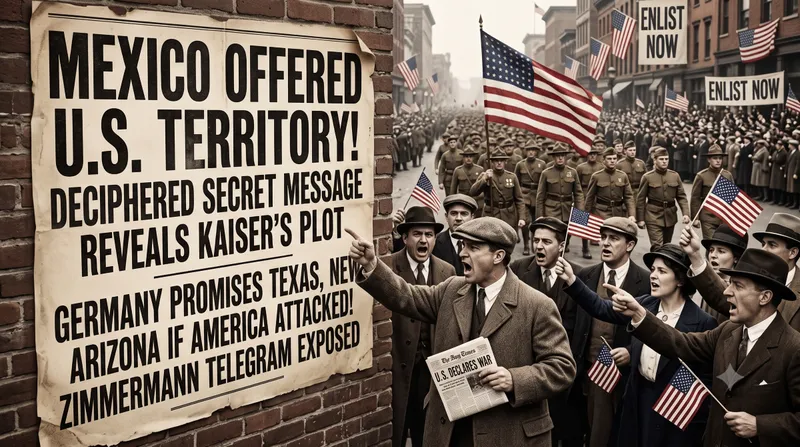
The Telegram That Dragged America Into War
A decrypted secret message offering Mexico lost U.S. territory in exchange for attacking America turned a hesitant nation into a belligerent one.
WOW Score
In January 1917, German Foreign Secretary Arthur Zimmermann sent a coded cable to Mexico proposing a military alliance: if the U.S. entered the war, Mexico should attack America, and Germany would help it recover 'lost territory in Texas, New Mexico, and Arizona.'
British naval intelligence intercepted and decrypted the message without Germany ever knowing. By February, they shared it with the United States. When the text was published in American newspapers in March, the public was incensed.
Two months later, President Woodrow Wilson asked Congress for a declaration of war. The telegram had done what years of submarine warfare had not: it made American entry into the war politically unavoidable.
"Germany promised Mexico Arizona, New Mexico, and Texas. British codebreakers handed the plan to Washington and changed American history."
Public outrage over the telegram helped push the United States Congress to declare war on Germany in April 1917. American troops and industrial might tipped the exhausted balance of the Western Front, ensuring Allied victory in 1918 and marking the United States' arrival as a global power.
The Full Story
Room 40's Quiet Triumph
The decryption was the work of Britain's Room 40, a secret codebreaking unit. To protect the source, the British staged a leak through a friendly Mexican telegraph office so Germany would blame its own lax security rather than suspect their cipher had been broken.
Why Mexico Said No
Mexican leaders rightly judged the offer fantasy. The country was embroiled in its own revolution and stood no chance against the United States. But the mere proposal confirmed American fears that Germany was a hostile power willing to arm its neighbors.
The Tipping Point
Unrestricted German submarine warfare had already angered Washington. The Zimmermann Telegram supplied the emotional jolt. Within weeks, the first American 'doughboys' were on their way to France, fundamentally altering the war's outcome.