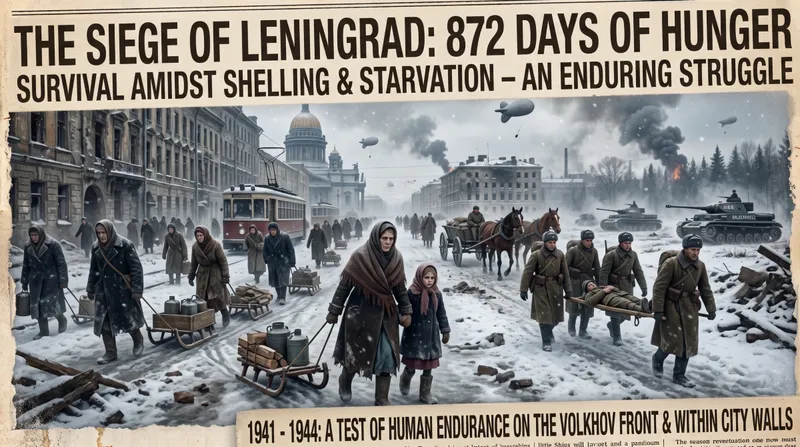
The Siege of Leningrad: 872 Days of Hunger
For nearly two and a half years, a great city starved behind German lines and refused to fall.
WOW Score
German and Finnish forces encircled Leningrad in 1941, intending to starve it into submission. Cut off from the rest of the country, the city's 2.5 million inhabitants faced a slow, systematic hunger.
Bread rations fell to a few ounces a day. Tram lines froze; fuel vanished; families burned books and furniture for warmth. The dead lay uncollected in the snow.
A tenuous lifeline across the frozen Lake Ladoga kept a trickle of supplies flowing. After 872 days, Soviet forces broke the encirclement in early 1944.
"People ate wallpaper paste and their dead to survive. The city held, and in holding became a symbol of Soviet defiance."
The siege killed an estimated one million civilians one of history's deadliest. Its memory became sacred in Russia, a testament to endurance that contrasted sharply with the regime's own callousness toward its citizens.
The Full Story
The Road of Life
In winter, trucks crossed the ice of Lake Ladoga carrying food in and evacuating children out. The 'Road of Life' was constantly bombed but kept the city alive through its worst winters.
A City That Would Not Die
Factories kept producing weapons even as workers starved. The cultural elite and ordinary families sustained a defiant civic life amid unimaginable deprivation.
The Cost of Survival
Estimates of civilian deaths reach a million. The siege remains a pillar of Russian national memory and a monument to endurance under total war.