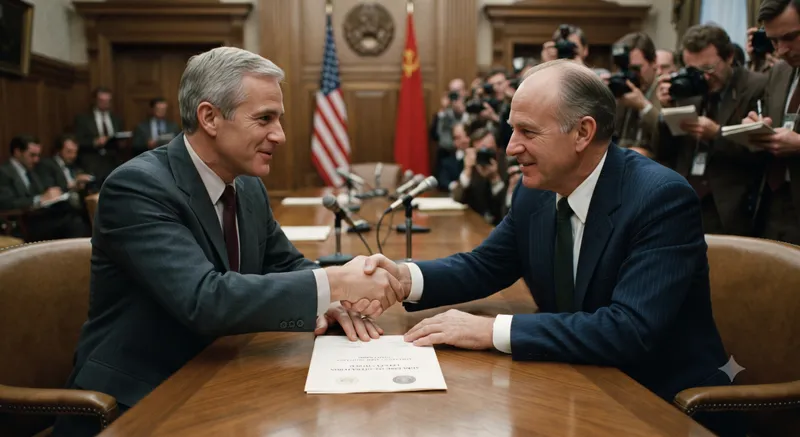
The SALT Treaties: Putting a Cap on the Arms Race
For the first time, the two nuclear superpowers agreed to stop the endless buildup of strategic weapons and to talk instead of threaten.
WOW Score
Strategic Arms Limitation Talks produced SALT I in 1972, the first accord capping the number of strategic ballistic missile launchers on both sides.
SALT II, signed in 1979, sought further limits, though the U.S. never ratified it after the Soviet invasion of Afghanistan. Both sides nonetheless observed its provisions.
The treaties turned arms control into a durable channel of superpower communication and helped stabilize the nuclear standoff.
"Two rivals with thousands of warheads agreed, on paper, to stop multiplying them. The arms race learned the word 'limit.'"
SALT I (1972) and SALT II (1979) established the principle of mutual, verifiable limits on strategic arms, easing Cold War tensions and creating frameworks that later treaties built upon. They marked the shift from confrontation toward managed coexistence.
The Full Story
From Threat to Talks
After the Cuban Missile Crisis, both sides recognized the danger of unconstrained rivalry and began negotiating limits rather than merely racing.
The ABM Constraint
SALT I also limited anti-ballistic missile systems, preserving the logic of mutual assured destruction and discouraging a defensive arms spiral.
A Lasting Framework
Though SALT II lapsed unfinished, its principles carried into later accords like START, shaping nuclear diplomacy for decades.