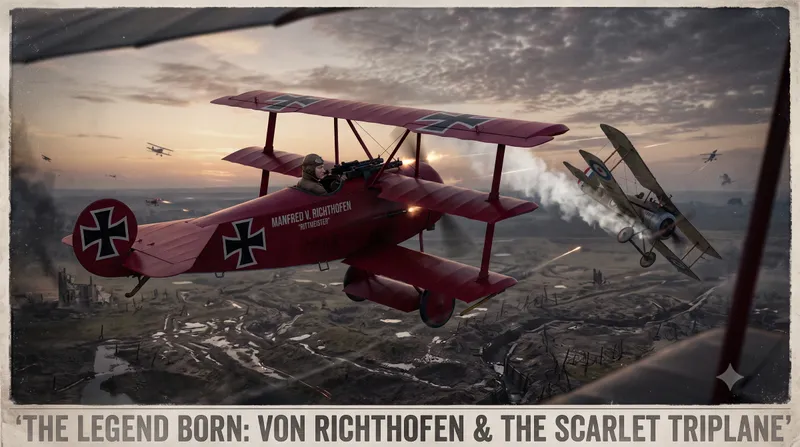
The Red Baron and the Birth of Air War
A scarlet-painted triplane and a man named Manfred von Richthofen turned aerial combat from reconnaissance into legend.
WOW Score
When the war began, aircraft were fragile scouts with no weapons. By 1915, pilots were firing pistols and then machine guns at one another, and dedicated fighter squadrons were born.
Manfred von Richthofen, a German aristocrat, became the war's most famous flyer. Flying a distinctive red plane, he claimed 80 aerial victories and led the elite 'Flying Circus' squadron.
He was shot down and killed in April 1918 at age 25. His death only amplified the legend of the Red Baron, the archetype of the fighter ace.
"Eighty kills in a crimson fighter made a nobleman into the deadliest ace of the war and into a myth that outlived the trenches."
WWI turned the airplane from a spotting tool into a weapon of pursuit, ground attack, and strategic bombing. The cult of the ace and the Red Baron above all shaped air power doctrine and popular imagination, foreshadowing the central role of air superiority in every later conflict.
The Full Story
From Observation to Duel
Early aviators waved at each other. Within months they carried rifles, then synchronized machine guns that fired through the propeller. Dogfighting was invented in the skies over Flanders.
The Cult of the Ace
Richthofen's crimson aircraft was as much a propaganda tool as a fighter. Both sides promoted their top pilots as heroes, turning air combat into a personal, chivalric drama above the mud.
Air Power Is Born
The war proved that control of the sky mattered. By 1918, bombers struck cities and coordination with ground forces was emerging the foundations of the air forces that would dominate the twentieth century.