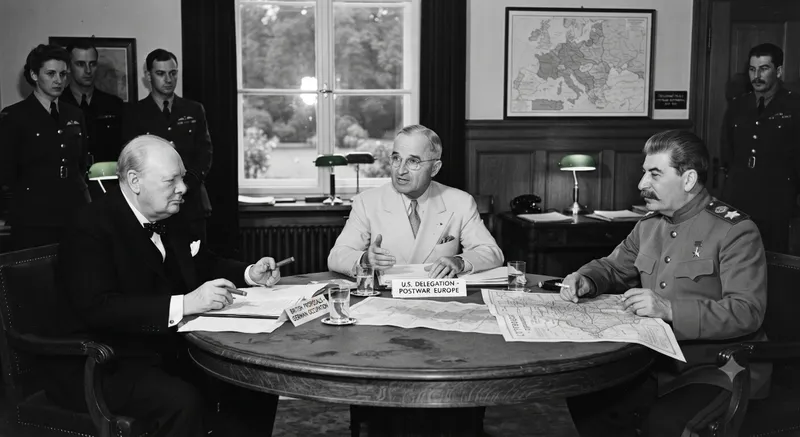
The Potsdam Conference: The War's Last Summit
As the atomic age dawned, the victorious powers met to impose the peace and revealed how far apart they already stood.
WOW Score
Held near Berlin after Germany's defeat, Potsdam brought together Truman (newly president), Stalin, and Churchill replaced mid-conference by Clement Attlee after a British election.
The leaders finalized the occupation and demilitarization of Germany, addressed reparations, and issued the Potsdam Declaration demanding Japan's unconditional surrender.
The conference coincided with the first successful atomic test, giving Truman new leverage and deepening the mistrust between East and West.
"Truman, Stalin, and a new Churchill (then Attlee) met as allies and left as the architects of two hostile blocs."
Potsdam set the terms for Germany's occupation, demilitarization, and denazification, and issued the ultimatum to Japan. It also marked the open emergence of Cold War divisions just as the U.S. tested its first atomic bomb.
The Full Story
The Atomic Factor
Word of the Trinity test reached Truman at Potsdam. The existence of the bomb altered the balance of the conference and the calculus toward Japan.
The Potsdam Declaration
Issued to Japan, it promised destruction if surrender was refused. Japan's failure to respond clearly led directly to the atomic bombings and the war's end.
The Iron Curtain's Outline
Disagreements over Poland and Germany's future exposed the rift that would harden into the Cold War within months.