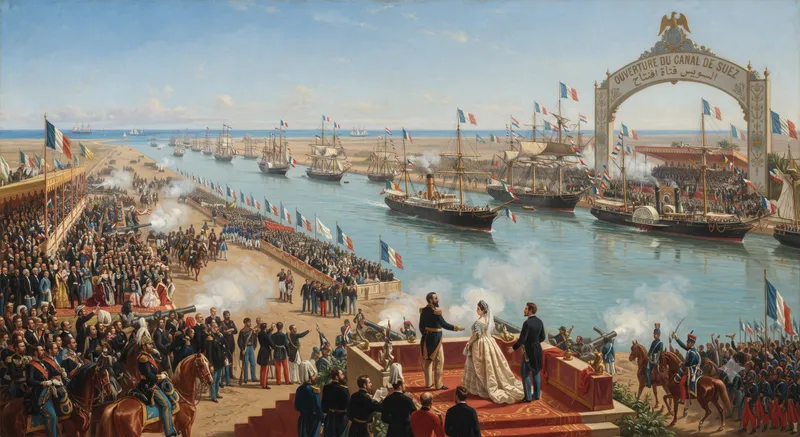
The Opening of the Suez Canal: Two Seas Made One
After a decade of digging, a man-made waterway joined the Mediterranean and the Red Sea and shrank the world by weeks of sailing.
WOW Score
Spearheaded by Ferdinand de Lesseps, the Suez Canal was dug across the Isthmus of Suez by enormous human labor over a decade.
It allowed ships to pass between Europe and the Indian Ocean without the long voyage around Africa, transforming global trade routes.
The canal quickly became vital to the British Empire's link to India and a prize of geopolitical struggle.
"A channel carved through the desert let ships sail from Europe to Asia without rounding a continent. Trade found a shortcut to the future."
Opened in 1869, the Suez Canal became the artery of global commerce and empire, later a flashpoint in the 1956 crisis. It remains one of the world's most strategic waterways.
The Full Story
A Canal Without Locks
Because the Mediterranean and Red Sea are at similar levels, Suez needed no locks, a rare advantage among great canals.
The Human Cost
Tens of thousands of Egyptian laborers dug the canal, many under harsh conditions, in a feat of 19th-century engineering.
The Lifeline of Empires
Control of Suez became a strategic obsession, culminating decades later in the 1956 Suez Crisis.