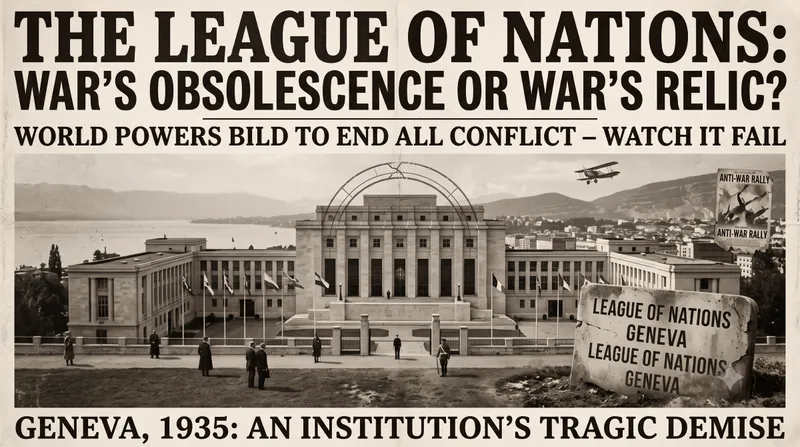
The League of Nations: Humanity's First Try at Peace
In the ashes of the Great War, the world's powers built an institution meant to make war obsolete and watched it fail.
WOW Score
President Woodrow Wilson made a league of nations the centerpiece of his postwar vision: an assembly where disputes would be settled by negotiation rather than bloodshed. The Covenant was written into the Versailles Treaty.
The League held its first meeting in 1920, with members pledging to protect each other's independence. But the United States Wilson's own idea never joined, and the body lacked its own army.
When aggressors tested it in the 1930s, the League issued condemnations but could not enforce them. It dissolved in the face of the war it was built to prevent.
"An idea ahead of its power: a parliament of nations that could speak, but barely act, when aggression came."
The League was the first global attempt at collective security. Its inability to stop Japan, Italy, and Germany in the 1930s discredited the concept yet it directly inspired the United Nations, whose charter and institutions are its descendants.
The Full Story
Wilson's Lost Cause
Wilson campaigned tirelessly for the League but could not win U.S. Senate approval. American absence fatally weakened the body from the start, depriving it of the world's strongest power.
Successes and Limits
The League did useful work on refugees, health, and labor standards, and settled a few minor disputes. But without the means to compel great powers, it could not face down aggression.
The UN's Ancestor
Out of the League's failure came hard-won lessons. The United Nations of 1945 kept the ideal of collective security but gave its Security Council real enforcement power the League's frustrated dream made practical.