The Korean War: The Cold War's First Hot Battle
In 1950, a civil war on a divided peninsula pulled in the world's great powers and set the template for superpower proxy war.
WOW Score
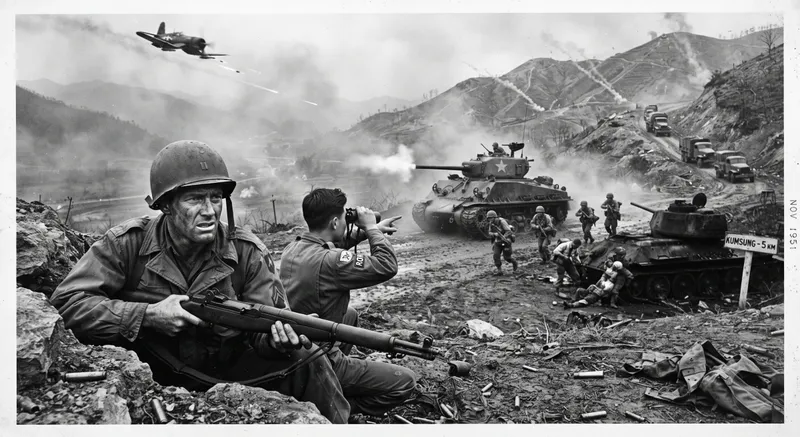
North Korea's invasion of the South in 1950 drew a swift U.S.-led UN response under a Security Council mandate. American forces landed at Inchon and pushed the North nearly to the Chinese border.
China then entered the war, driving the UN forces back in a brutal seesaw. The fighting stabilized near the original dividing line.
An armistice in 1953 ended the shooting but not the war. Korea remains divided, and technically still at war, to this day.
"A border crossed at dawn became a war that dragged in China, the U.S., and the UN and never formally ended."
The Korean War cemented the division of the peninsula at the 38th parallel and demonstrated that the U.S. would contain communism by force. It expanded the Cold War into Asia and left a tense, militarized border that persists today.
The Full Story
Inchon and Its Consequences
MacArthur's daring amphibious landing at Inchon reversed the war's momentum and tempted an advance to the Yalu River that triggered Chinese intervention.
A Stalemate in the Snow
The conflict became a grinding war of position in harsh terrain, with enormous civilian suffering and entire cities reduced to rubble.
An Armistice, Not Peace
The 1953 agreement fixed the DMZ roughly where the war began. No peace treaty was ever signed, leaving one of the world's most dangerous frontiers.