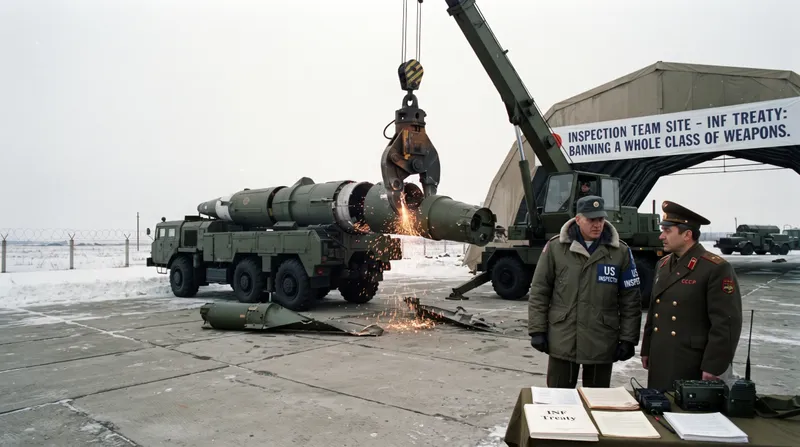
The INF Treaty: Banning a Whole Class of Weapons
In 1987, the superpowers did something radical they agreed to eliminate an entire category of nuclear missiles, and actually did it.
WOW Score
By the 1980s, the deployment of U.S. and Soviet intermediate-range missiles in Europe had brought the nuclear standoff to the continent's doorstep.
At a 1987 summit, Reagan and Gorbachev agreed to eliminate all ground-launched ballistic and cruise missiles of that range a first in which nuclear weapons were not merely limited but destroyed.
Nearly 2,700 missiles were verifiably dismantled. The treaty was a centerpiece of the winding down of the Cold War.
"For the first time, nuclear arms were not just capped but destroyed thousands of them, verified on the ground. Trust, briefly, was built."
The Intermediate-Range Nuclear Forces Treaty removed an entire class of land-based missiles from Europe, easing the continent's most acute nuclear tension. It became a landmark of arms control and a symbol of the thaw that ended the Cold War until its collapse in 2019.
The Full Story
The Double-Zero Option
The deal removed the weapons from Europe entirely on both sides the 'zero-zero' solution that had once seemed impossible.
On-Site Verification
For the first time, inspectors were allowed into each other's facilities, building a rare measure of real confidence between the rivals.
An End and a Warning
The treaty held for three decades before the U.S. and Russia withdrew, a reminder of how hard-won and how fragile such agreements can be.