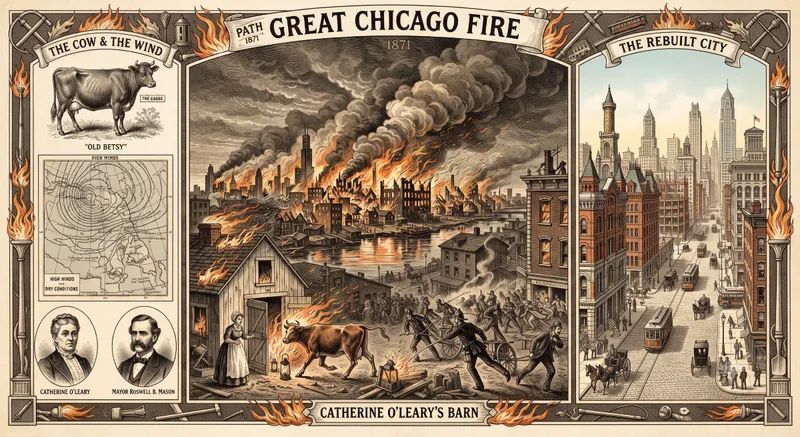
The Great Chicago Fire: The Cow, the Wind, and the Rebuilt City
In two days, a fire erased a booming frontier city and legend blamed a cow, while Chicago blamed its own wooden sprawl.
WOW Score
After a summer of drought, a fire broke out in southwest Chicago and, driven by prairie winds, tore through the city's wooden buildings and sidewalks.
It jumped the river repeatedly, consuming homes, hotels, and the business district before rain finally quenched it.
Though the cow-and-barn tale is likely myth, the disaster exposed how a fast-growing city had built itself from kindling.
"A long dry summer and a city of wood met a spark. Chicago burned then rebuilt bigger, bolder, and fireproof."
The fire killed hundreds and left a third of the city homeless, but became a catalyst for Chicago's reinvention as a center of architecture and industry. It birthed modern fire codes and the skyscraper age.
The Full Story
The Myth and the Reality
Catherine O'Leary's cow is the famous culprit, but the true origin is unknown. What is certain is the city's lethal reliance on wood.
A City in Ashes
About 300 people died and 100,000 were left homeless; the physical damage was among the worst in U.S. history to that point.
Rising From the Ruins
Chicago rebuilt with steel, stone, and ambition, soon pioneering the skyscraper and becoming the archetype of the modern American city.