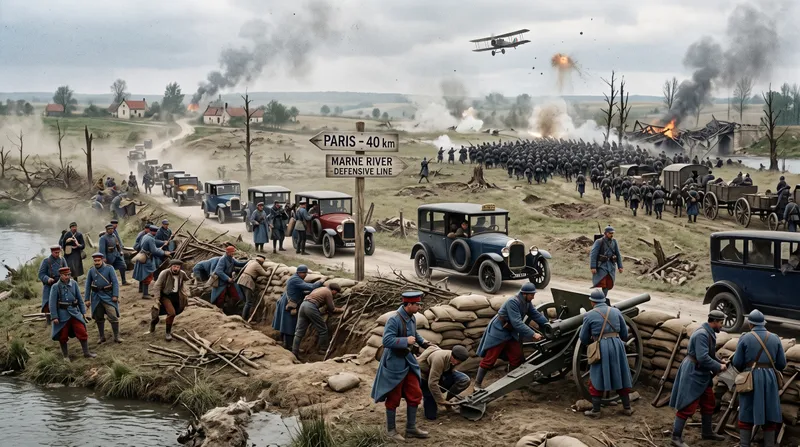
The Marne: The Miracle That Saved Paris
A week of desperately improvised defense in September 1914 halted the German dash for Paris and ruined the Schlieffen Plan for a quick victory.
WOW Score
Germany's Schlieffen Plan depended on crushing France within weeks by sweeping through Belgium and around Paris. By early September 1914, German armies were within striking distance of the capital.
French and British forces launched a counteroffensive along the Marne. Legend has it that Parisian taxis ferried reserves to the front; the reality was a frantic, improvised defense that exploited a gap opening in the German right flank.
The Germans withdrew, abandoning the hope of swift victory. Within weeks, both sides were entrenching, and the Western Front froze into the lines that would define the war.
"Paris taxis ferried reserve troops to the front. In a single week, the war of movement died and the trenches were born."
The German retreat to the Aisne ended any hope of a short war. Both sides then raced to the sea, digging the continuous trench lines that would lock Europe in four years of stalemate. The Marne turned WWI from a sprint into a siege of continents.
The Full Story
The Gap in the Line
As German armies pivoted east of Paris, a fatal gap opened between their First and Second Armies. Allied commanders spotted it and drove a wedge through, threatening to encircle the German right.
The Taxis of the Marne
General Gallieni used Paris's fleet of taxis to rush thousands of troops to the front a stunt more symbolic than decisive, but one that captured the desperate, total nature of the moment.
The Race to the Sea
After the Marne, each side tried to outflank the other northward, digging as they went until the trenches reached the English Channel. The war of movement was over.