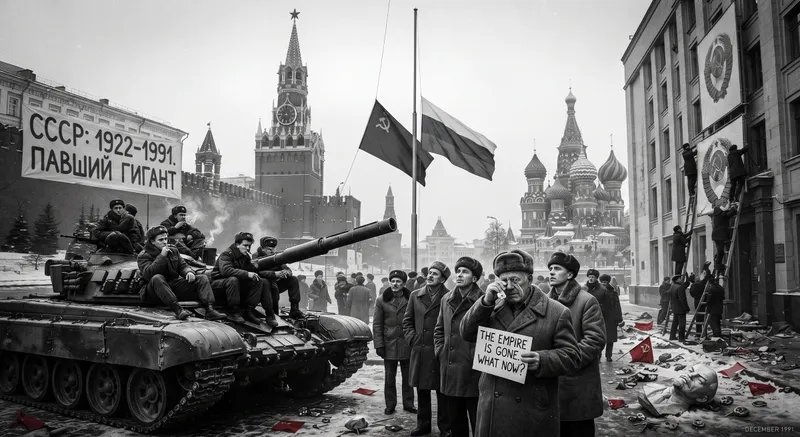
The Fall of the Soviet Union: The Empire That Vanished
In a single year, the world's other superpower dissolved peacefully and redrew the map of Eurasia overnight.
WOW Score
Years of economic stagnation, reform attempts, and rising nationalism eroded the Soviet system. Gorbachev's policies of glasnost and perestroika loosened control faster than they could manage it.
In 1991, a failed hardline coup against Gorbachev shattered the remaining authority of the center. Republics declared independence one by one.
On December 26, 1991, the USSR ceased to exist, replaced by the Commonwealth of Independent States and a new Russia under Boris Yeltsin.
"No shots were fired to end the empire that had threatened the world with annihilation. A flag came down, and fifteen nations were born."
The dissolution ended the Cold War, removed the bipolar contest that had shaped global life for decades, and unleashed turbulent transitions across the former Soviet space. It left the United States as the sole superpower and redrew Europe's borders.
The Full Story
The Reforms That Unmade It
Glasnost opened public life; perestroika tried to fix the economy. Together they unleashed forces nationalism, dissent, exposure of failure the system could not contain.
The August Coup
Conservatives' attempt to seize power backfired, rallying the public around Yeltsin and demolishing the credibility of the old guard.
A Peaceful End
Unlike empires of the past, the Soviet collapse was largely non-violent at the center. The geopolitical consequences, however, reshaped the world instantly.