The Fall of Constantinople: The End of the Middle Ages
After a thousand years, the last remnant of Rome fell to the Ottoman cannon and the medieval world closed for good.
WOW Score
The Byzantine capital, reduced to a shadow of its former glory, stood as Christendom's eastern bulwark against the rising Ottoman Empire.
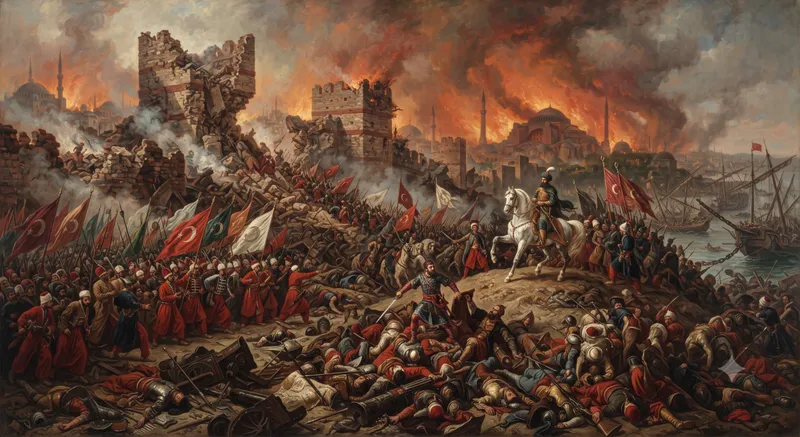
Sultan Mehmed II besieged the city with a massive army and giant cannons that battered its ancient walls. After a desperate defense, the fortifications were breached.
The city fell, becoming Istanbul, and the last direct link to Roman antiquity was severed.
"The great cannon pounded the walls for weeks. When they broke, the city that had outlasted empires fell in a single night."
The Ottoman capture of Constantinople ended the Byzantine Empire, shifted the center of gravity to Istanbul, and prompted European powers to seek new trade routes helping spark the Age of Exploration.
The Full Story
The Walls That Held for a Millennium
Constantinople's triple land walls had repelled countless sieges. Ottoman siege guns a new technology finally broke them.
A Civilization's Last Stand
Emperor Constantine XI died fighting. The fall sent shockwaves through Europe and is often dated as the end of the Middle Ages.
The Route to the New World
With overland trade to the East now controlled by the Ottomans, Europeans sought sea routes Columbus and da Gama followed in its wake.