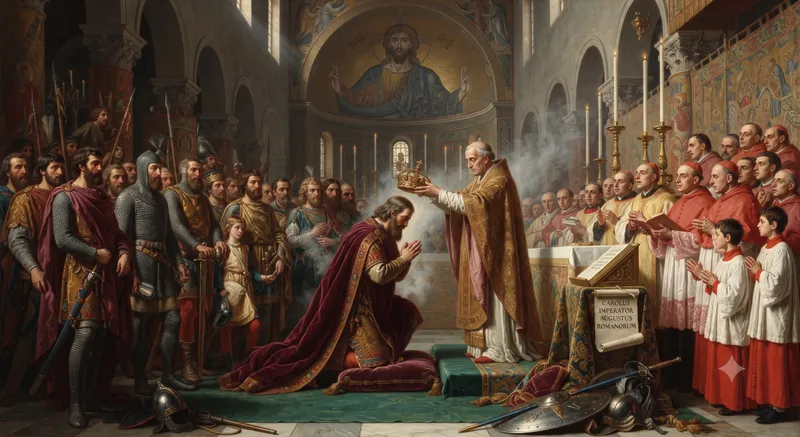
The Coronation of Charlemagne: The Birth of Europe
On Christmas Day in Rome, a Frankish king was crowned Emperor by the pope reviving the idea of a Western Roman Empire.
WOW Score
Charlemagne had unified much of Western Europe under Frankish rule through decades of war and conversion. On Christmas Day, he knelt in St. Peter's Basilica in Rome.
Pope Leo III placed the imperial crown on his head, proclaiming him Emperor of the Romans. The act tied secular power to the church's blessing.
The coronation revived the imperial title in the West and laid the foundation for the medieval Holy Roman Empire.
"A crown placed on a king's head by the pope fused sword and altar and founded the political idea of Christendom."
Charlemagne's coronation bridged the fall of Rome and the medieval order, linking Germanic kingship with Roman and Christian authority. It inspired the later Holy Roman Empire and shaped the identity of Western Europe for a millennium.
The Full Story
A Surprise Crown?
Accounts differ on whether Charlemagne expected the coronation, but the symbolism was clear: the emperor now received legitimacy from the pope.
The Carolingian Renaissance
Charlemagne's court fostered learning, reform of script, and administration, a cultural revival that preserved much of classical heritage.
The Empire's Long Shadow
The title and idea persisted as the Holy Roman Empire until 1806, shaping Europe's political and religious map for centuries.