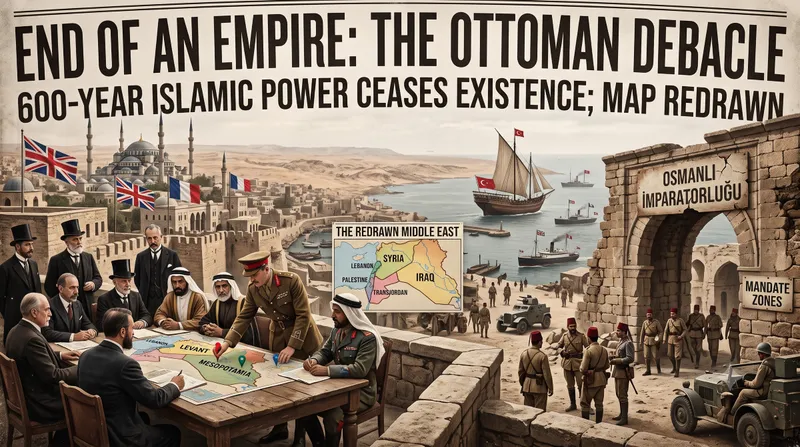
The Fall of the Ottoman Empire
A 600-year-old Islamic empire entered WWI on the losing side and by 1922 it had ceased to exist, redrawing the entire Middle East.
WOW Score
The Ottoman Empire had been in decline for centuries when it allied with Germany in 1914, hoping to revive its fortunes. Instead, defeat accelerated its disintegration.
As the empire collapsed, its Arab provinces were occupied and partitioned by Britain and France under mandate authority. The Turkish heartland itself was threatened with dismemberment.
A nationalist uprising led by Mustafa Kemal (Ataturk) saved Anatolia and abolished the sultanate in 1922, founding the secular Republic of Turkey from the empire's core.
"The 'sick man of Europe' drew its final breath in the war's aftermath, leaving a map of new states and old grievances behind."
The empire's collapse dismantled centuries of order across the Middle East, the Balkans, and North Africa. Its territories were carved into mandates and new nations, setting borders and tensions that still drive regional conflict a century later. Out of its ruins rose modern Turkey under Ataturk.
The Full Story
The Young Turk Gamble
The reformist Young Turks believed alliance with Germany would modernize and preserve the empire. The opposite happened: military defeat exposed its weakness and invited partition.
Mandates and New Maps
The League of Nations granted Britain and France control of Iraq, Palestine, Transjordan, Syria, and Lebanon. Borders were drawn with little regard for ethnic or sectarian realities, sowing discord that endures.
Birth of Modern Turkey
Ataturk's revolution rejected the imperial past, abolished the caliphate, and built a secular nation-state a decisive break that reshaped Turkish identity to this day.