The Christmas Truce: The Day the Guns Fell Silent
On Christmas Eve 1914, enemy soldiers climbed out of the trenches, shook hands in No Man's Land, and kicked a football across the frozen mud of Flanders.
WOW Score
By late 1914, the Western Front had frozen into a lethal stalemate. Two vast systems of waterlogged trenches stretched from the Belgian coast to the Swiss border, separated by a strip of blasted earth called No Man's Land. The men who stared across it spoke the same words, ate the same rations, and died in the same mud.
On Christmas Eve, German soldiers began lighting candles on the lip of their trenches and singing 'Stille Nacht' Silent Night. British and French troops, hearing the carols drift through the cold, answered with their own songs. Then came the shouts: 'You no shoot, we no shoot.'
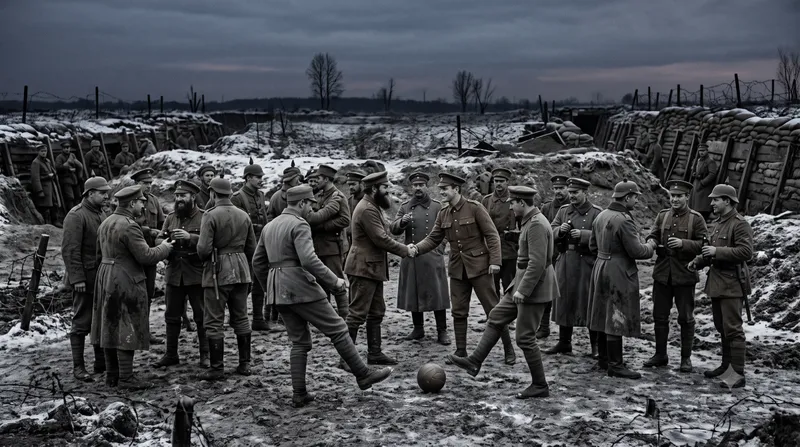
On Christmas Day, soldiers from both sides climbed over the parapets and met in the middle. They exchanged cigarettes, plum pudding, and buttons. In several sectors they organized impromptu football matches with improvised balls. The unofficial ceasefire spanned roughly 100 miles of the front and involved tens of thousands of men.
"For one night, the war forgot itself. Thousands of men chose shared humanity over the orders that told them to kill."
The truce exposed a dangerous truth to every high command: given a chance, their men would rather fraternize than fight. It never happened on that scale again. From 1915 onward, commanders banned fraternization, scheduled artillery barrages on Christmas Day, and weaponized propaganda to strip the enemy of its humanity. The brief peace on the Western Front became the most powerful argument against the dehumanization of total war.
The Full Story
The Truce That Nobody Ordered
The Christmas Truce was not the work of any commander. It grew from the bottom up, sparked by the ordinary rituals of the season. German troops decorated small trees with candles; their rivals responded with curiosity rather than rifle fire. What began as a quiet night of singing became, by dawn, a spontaneous peace. Officers on both sides mostly looked the other way, recognizing that the men had earned a moment of grace.
Football in No Man's Land
The most enduring image of the truce is the football match. Accounts from multiple sectors describe soldiers kicking makeshift balls across the frozen ground, with one German veteran recalling his side winning 3-2. Whether the scores are precise or legend, the act itself was real and radical: enemies who hours earlier had been trying to kill one another now competed, laughed, and argued over the rules like any Sunday park team.
Why It Never Happened Again
When news of the fraternization reached the general staffs, they were alarmed rather than moved. A soldier who had shared a cigarette with the enemy was a soldier far less willing to bayonet him. From 1915, orders explicitly forbade truces. Artillery bombardments were deliberately timed for Christmas Day to shatter any repetition. The brief, improbable peace of 1914 became a one-time rupture in the machinery of war a reminder of what the men in the trenches might have chosen instead.