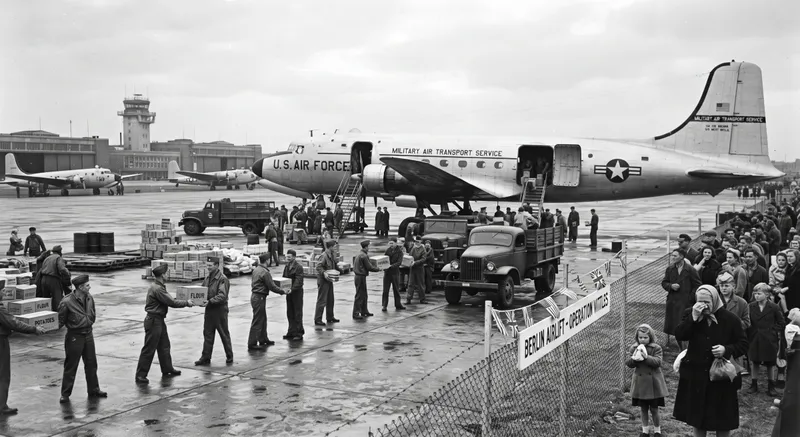
The Berlin Airlift: Feeding a Blockaded City
When the Soviets cut off West Berlin by land, the Allies answered with a miracle of logistics: one airplane landing every minute, for nearly a year.
WOW Score
After WWII, Berlin lay deep inside Soviet-occupied Germany, split into sectors. In 1948, Stalin cut all road, rail, and canal access to the Western sectors, betting the Allies would abandon the city.
Instead, the U.S. and Britain launched an unprecedented airlift, flying in food, coal, and medicine around the clock. At its peak, a plane landed in West Berlin every minute.
After 11 months and over two million tons of cargo, the Soviets lifted the blockade. The airlift had become one of the Cold War's defining acts of resolve.
"A city of two million could not be starved into surrender when the sky itself became a highway. The West flew freedom in by the ton."
The airlift broke the blockade without firing a shot, cementing the division of Europe and the commitment of the U.S. to defend West Berlin. It turned a crisis into a propaganda triumph and helped birth NATO and the Federal Republic of Germany.
The Full Story
Operation Vittles
American and British crews flew brutal shifts through weather and exhaustion. Ground crews in Berlin worked nonstop to unload and refuel, keeping the pipeline flowing.
The Candy Bombers
Pilots like Gail Halvorsen dropped candy tied to tiny parachutes to Berlin's children, turning the airlift into a human story of compassion amid confrontation.
A City Held
The blockade's failure convinced Stalin that the West would not yield. It accelerated the formal split of Germany into two states and the militarization of the Cold War.