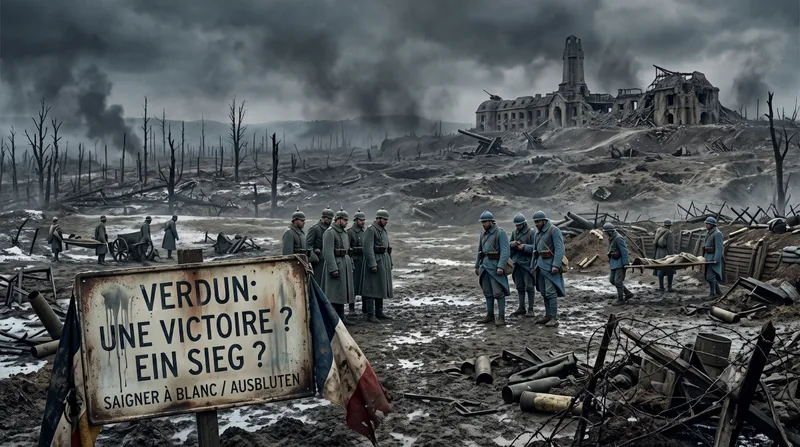
Verdun: Ten Months of Meat Grinder Warfare
The Germans chose Verdun not to capture it, but to bleed France white. Instead, both empires drained themselves in the longest battle of WWI.
WOW Score
Germany's Chief of Staff Erich von Falkenhayn aimed not to take Verdun but to 'bleed France white' by attacking a position the French could not abandon for pride. He expected French sacrifices to exhaust the nation.
Instead, both sides poured men into a shifting hell of fortresses, artillery, and mud. The battle became a contest of endurance in which neither side could afford to retreat.
By December, after nearly ten months, the front had barely moved. Hundreds of thousands were dead or wounded on each side, and the word Verdun became shorthand for senseless sacrifice.
"They shall not pass. Verdun became a test of national will where hundreds of thousands died for a few square kilometers of scorched earth."
Verdun became sacred to France a symbol of national resistance and sacrifice. The enormous casualties on both sides exhausted armies and shaped the brutal attrition strategy that defined the rest of the war. The phrase 'the spirit of Verdun' echoed through French memory for generations.
The Full Story
The Fortress and the Will
Verdun's ring of forts, especially Fort Douaumont, became totems. When Douaumont fell to a small German raiding party almost unopposed, French honor demanded its recapture at any cost.
Artillery's Dominion
Verdun was above all a battle of shells. Millions of artillery rounds turned forests to splinters and soil to craters. The infantry who survived did so in trenches that flooded with rain and blood.
A Pyrrhic Calculation
Falkenhayn's plan backfired: Germany lost nearly as many men as France. Verdun hardened French resolve rather than breaking it, and the trauma etched itself into the national psyche.