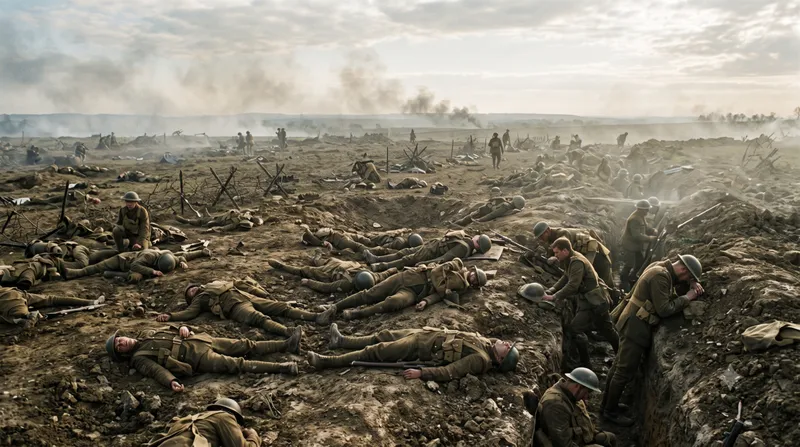
The Somme: The Bloodiest Day in British History
At 7:30 AM on July 1, 1916, the British Army walked into the open and lost nearly 20,000 men before nightfall the worst single day in its history.
WOW Score
The Somme was intended as a joint Franco-British offensive to break the German line. Commanders believed a massive week-long artillery bombardment had destroyed the enemy trenches. They were wrong: German troops sheltered in deep dugouts and emerged with their machine guns intact.
When the British infantry advanced in neat lines, they were mown down. July 1, 1916 remains the deadliest day in the history of the British Army, with close to 60,000 casualties.
The battle dragged on for months through rain and mud, eventually grinding forward only a few miles at enormous cost and introducing the tank to the battlefield.
"A week-long artillery barrage was supposed to erase the German lines. It didn't. The men went over the top into machine guns that had simply waited underground."
The Somme became the symbol of WWI's industrial slaughter and the futility of attrition warfare. Over 141 days, more than a million men were wounded or killed for a few miles of mud. The battle also saw the first use of tanks in history, hinting at the future of war.
The Full Story
The Barrage That Failed
British guns fired over a million shells, but many were duds or aimed at the wrong targets. German defenses, dug deep into chalk, survived. When the bombardment lifted, the defenders climbed back to their posts and waited.
The First Tanks
On September 15, 1916, the British deployed tanks for the first time at Flers-Courcelette. Primitive and unreliable, they nonetheless startled the enemy and pointed toward a new kind of warfare one where the machine, not the marching column, would dominate.
A Generation Lost
The Somme devastated an entire generation of British, French, and German men. Whole villages lost their young men; the psychological wound to Europe would outlast the war itself.