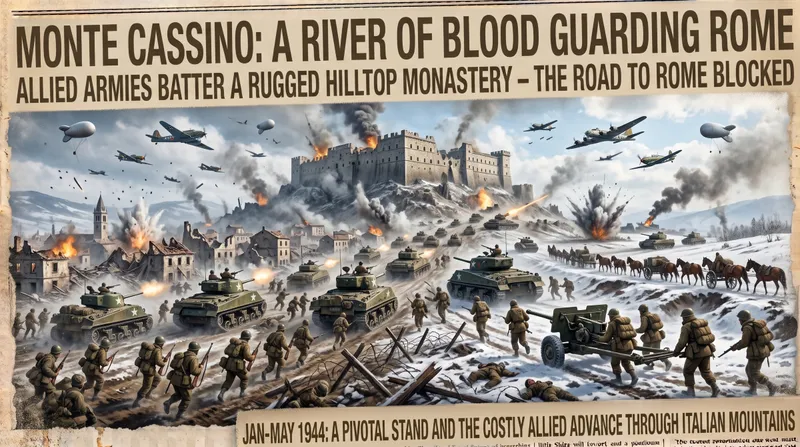
Monte Cassino: The Bloody Gate to Rome
For months, Allied armies battered a rugged hilltop monastery that guarded the road to Rome and paid in rivers of blood.
WOW Score
The Abbey of Monte Cassino sat atop a hill dominating the route to Rome. German paratroopers turned the rugged terrain into a fortress that stopped the Allied advance up the Italian peninsula.
Four major battles saw repeated assaults by diverse Allied forces including Polish, Indian, New Zealand, and U.S. troops across flooded valleys and contested heights.
Only after a final push and a risky amphibious flanking landing did the Germans withdraw, and the Allies entered Rome in early June 1944.
"Four brutal assaults, a bombed monastery, and a river of casualties all to crack a door that would not open."
The eventual Allied breakthrough at Cassino opened the Liri Valley and led to the capture of Rome in June 1944. The campaign was among the war's bloodiest in the Italian theater and highlighted the grinding cost of the 'soft underbelly' strategy.
The Full Story
The Bombing of the Abbey
Allied commanders, believing the monastery was used as an observation post, bombed it in February 1944. The rubble made better cover for the defenders, and the destruction became controversial.
A Multinational Grind
Troops from across the Allied world fought there. The Polish flag raised over the ruins in May became one of the campaign's enduring images.
The Road to Rome
With Cassino fallen, the Gustav Line collapsed and the Allies took Rome on June 4, 1944 just two days before D-Day.