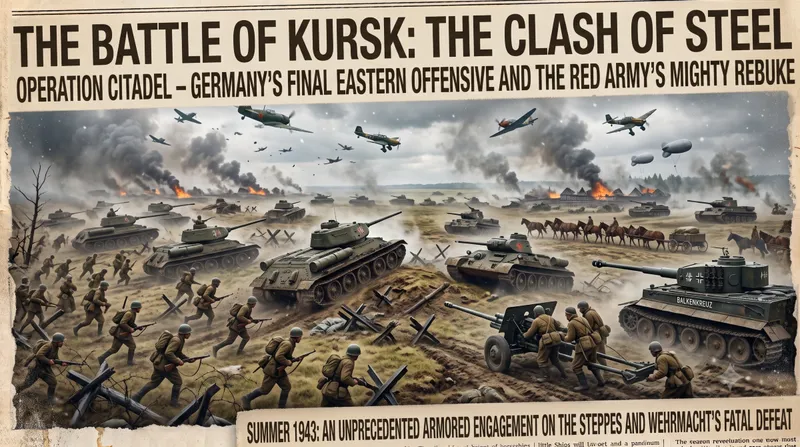
The Battle of Kursk: The Clash of Steel
In July 1943, the largest tank battle in history erupted on the steppes and broke the back of the German offensive for good.
WOW Score
Germany launched a massive armored pincer against the Kursk salient, hoping to cut off a huge Soviet bulge. The Soviets, forewarned, had dug miles of defenses and layered anti-tank guns.
At Prokhorovka, thousands of tanks clashed in close combat. Germany's new Tigers and Panthers were superior individually but outnumbered and outproduced.
The offensive stalled and the Red Army counterattacked, retaking the initiative and pushing west for the remainder of the war.
"Thousands of tanks met head-on in a roar of steel. When it ended, Germany would never again attack on the eastern front."
Kursk was the last major German offensive in the east. After it, the initiative passed permanently to the Red Army, which advanced westward toward Germany for the rest of the war. It also showcased the maturing power of Soviet armor and industry.
The Full Story
The German Gamble
Hitler delayed the attack for months to field new heavy tanks, costing the element of surprise. The wait let the Soviets fortify the salient into a killing zone.
Prokhorovka
Often called the largest tank battle ever, the meeting engagement at Prokhorovka saw hundreds of armored vehicles locked in chaos. Neither side 'won' cleanly, but Germany could not sustain the losses.
The Tide Turns
After Kursk, the Wehrmacht was permanently on the defensive in the east. The Red Army's offensive momentum never fully broke again.