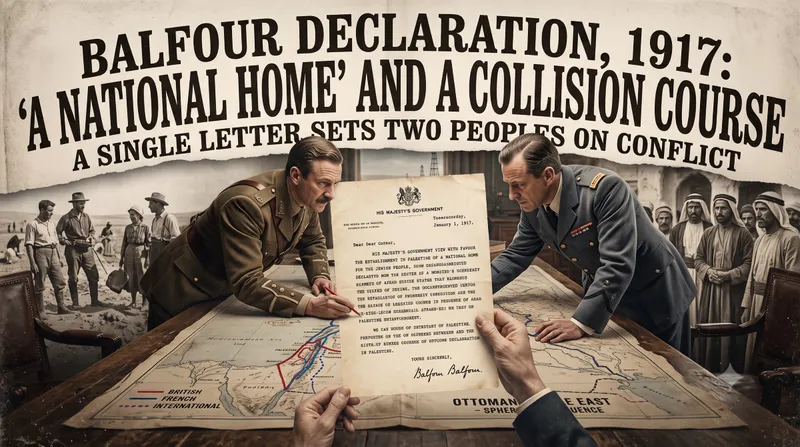
The Balfour Declaration: A Letter That Shaped a Century
A single letter in 1917 promised a 'national home for the Jewish people' in Palestine and set two peoples on a collision course.
WOW Score
In a letter from Foreign Secretary Arthur Balfour to Lord Rothschild, the British government expressed support for 'the establishment in Palestine of a national home for the Jewish people,' while pledging not to prejudice the rights of existing non-Jewish communities.
The declaration had multiple motives: courting global Jewish support for the Allied war effort, and securing a strategic foothold in the Near East.
It was adopted into the League of Nations Mandate and became a cornerstone of Zionist legitimacy and a point of deep contention with Palestine's Arab majority.
"With one paragraph, Britain committed to a homeland in a land it did not own and whose people it had promised to others."
The Balfour Declaration became the foundational international endorsement of Zionism and was incorporated into the British Mandate for Palestine. It accelerated Jewish immigration and set the stage for the Arab-Israeli conflict that defines Middle Eastern politics to this day.
The Full Story
A Wartime Calculation
Britain weighed the declaration as both moral and strategic: it hoped to win Jewish opinion in the United States and Russia and to anchor its position in the Middle East after the expected Ottoman defeat.
Contradictory Commitments
Balfour sat uneasily beside the Hussein-McMahon correspondence promising Arab independence and the Sykes-Picot carve-up. The overlapping, incompatible pledges ensured future conflict.
The Long Consequence
Immigration rose in the following decades, tensions with the Arab population grew, and the declaration's legacy is still debated wherever the question of Palestine is discussed.